IGF-1 Explained: The Biomarker Behind GH Secretagogue Research
What IGF-1 is, how the GH-to-liver-to-IGF-1 axis works, why researchers measure IGF-1 instead of GH, and how sermorelin, CJC-1295, tesamorelin, ipamorelin and IGF-1 LR3 relate to it.
TL;DR: Why IGF-1 is the number researchers watch
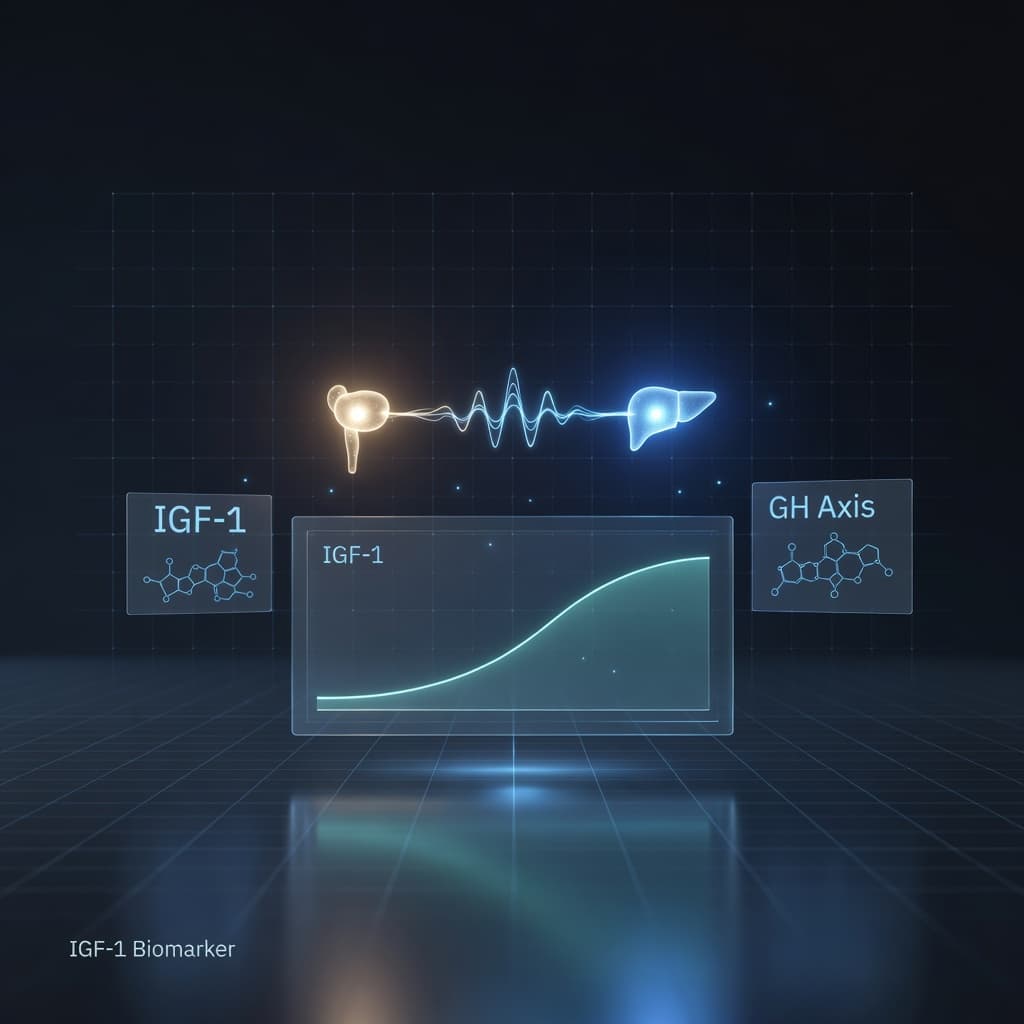
IGF-1 (insulin-like growth factor 1) is made mainly by the liver in response to pituitary growth hormone (GH), which makes it the principal endocrine output of the GH axis (PMID 15645308). It is measured instead of GH because GH is secreted in sharp pulses with wide daily swings, while IGF-1 is buffered by binding proteins and stays stable, integrating roughly a day of GH output (PMID 7758431). GH secretagogues converge on it: sermorelin, CJC-1295 and tesamorelin (GHRH-receptor agonists) and ipamorelin (a ghrelin-receptor agonist) all raise GH, which raises hepatic IGF-1, so serum IGF-1 is the shared downstream marker (PMID 16352683, 9849822, 18057338). IGF-1 LR3 is different: it is not a secretagogue but a modified IGF-1 that evades binding proteins and acts directly at the IGF-1 receptor (PMID 1311930). Not inherently "good": IGF-1 is a poor single-point diagnostic (PMID 34373538), and chronically high IGF-1 carries epidemiological cancer-risk associations. This is a laboratory biomarker, not a therapy target for a reader to pursue.
Ask what a GH secretagogue "does" in the research literature and the honest answer usually comes back to one number: IGF-1. It is the readout used to tell whether the growth-hormone axis has actually been pushed, the marker that trials report, and the concept that ties together several otherwise different compounds. This article explains what IGF-1 is, how the signal travels, why researchers measure it rather than GH itself, and how the stocked compounds relate to it. It is a biomarker and mechanism explainer, not a product guide and not a how-to, and everything is written for laboratory research context only.
Growth hormone secretagogues and gonadotropins
What IGF-1 Actually Is
Insulin-like growth factor 1 is a small protein hormone structurally related to insulin. Although many tissues make some IGF-1 locally, the dominant source of the circulating (endocrine) pool is the liver, acting under the instruction of pituitary GH. Liver-specific deletion of the igf1 gene in mice sharply lowers circulating IGF-1, which established hepatic IGF-1 as the principal endocrine output of the GH axis (PMID 15645308). In research terms, that is why IGF-1 is treated as the axis's "output signal": when GH drive goes up, hepatic IGF-1 follows.
The GH to Liver to IGF-1 Axis
The signal travels in a defined sequence. The hypothalamus releases GHRH (and ghrelin-receptor input adds to it), which triggers pituitary somatotrophs to release GH in pulses, with somatostatin restraining the system. GH then acts on hepatic GH receptors to drive IGF1 gene transcription, and liver-specific deletion of the igf1 gene sharply lowers circulating IGF-1, which established the liver as the dominant source of the endocrine pool (PMID 15645308). Circulating IGF-1 in turn provides negative feedback on GH release, closing the loop, with IGF-1 at its output end.
Why Researchers Measure IGF-1 Instead of GH
Pulses versus an integrated readout
GH is secreted in sharp pulses with wide diurnal swings, so a single GH blood draw is close to uninterpretable; it might catch a peak or a trough. IGF-1 is produced continuously and buffered in a binding-protein reservoir, giving it a longer half-life and steadier levels than GH, so it reflects GH output integrated over a longer window than any single GH draw. A rising IGF-1 therefore indicates sustained increased GH-axis drive rather than a momentary spike (PMID 7758431). This is reinforced by the finding that even under continuous GHRH-analog stimulation, GH keeps its pulsatile pattern while the integrated output rises (PMID 17018654).
Half-Life and the Binding-Protein Reservoir
Almost all serum IGF-1 is not free. It circulates bound to IGF-binding proteins, chiefly IGFBP-3, in a ternary complex with the acid-labile subunit (ALS). The binding proteins do two things at once: they greatly extend IGF-1's half-life relative to free IGF-1 and GH, and they modulate how much reaches the type-1 IGF receptor (IGF-1R) (PMID 7758431). This reservoir is the physical reason serum IGF-1 is stable enough to be a usable biomarker.
GH Secretagogues and Their IGF-1 Signature
The secretagogues below are studied for their ability to raise the subject's own GH, which in turn raises hepatic IGF-1, so IGF-1 serves as the shared downstream pharmacodynamic marker. Direct human IGF-1 data here exist for CJC-1295 DAC and tesamorelin; ipamorelin's supporting data are in vitro and animal. They differ in receptor, duration and how much human evidence exists.
Sermorelin is the acetate of GHRH(1-29), the short active fragment of GHRH. In non-GH-deficient short children, GHRH(1-29)NH2 raised mean height velocity from 4.8 to 7.2 cm per year over 12 months, showing that stimulating endogenous GH raises the downstream growth and IGF-1 readout (PMID 7955460).
CJC-1295 in its DAC form is a long-acting GHRH analogue. In healthy adults, a single dose of the DAC (drug-affinity-complex) version produced dose-dependent 2- to 10-fold rises in mean GH and 1.5- to 3-fold rises in IGF-1 lasting 9 to 11 days, with an estimated half-life of 5.8 to 8.1 days and IGF-1 staying above baseline up to about 28 days after repeated dosing (PMID 16352683). Importantly, that durable elevation is specific to the DAC form; the stocked CJC-1295 is the shorter "Mod-GRF(1-29)" no-DAC variant, which does not carry the same human duration data.
Tesamorelin is a stabilised GHRH analogue and the only approved molecule here: FDA-approved in the US for HIV-associated lipodystrophy, and not authorised in the EU. In a 412-patient randomised trial it reduced visceral adipose tissue by about 15.2 percent versus a 5.0 percent increase on placebo and raised IGF-1, with IGF-1 used as the pharmacodynamic marker (PMID 18057338); a later JAMA trial reproduced the visceral-fat and liver-fat effect with a rising IGF-1 (PMID 25038357).
Ipamorelin works through a different receptor. It is a selective ghrelin-receptor (GHS-R1a) agonist that releases GH with potency comparable to older GHRPs but, unlike GHRP-2 and GHRP-6, without materially raising ACTH, cortisol or prolactin (PMID 9849822). Its selectivity data are preclinical.
GHRH-receptor pathway research
GHRH(1-29) analog for physiological growth hormone stimulation research
CJC-1295 without DAC (Mod GRF 1-29) is a short-acting GHRH(1-29) analog for GH/IGF-1 research. Research-grade lyophilized powder, specified purity >=99% (HPLC). Laboratory use only.
Modified GHRH analog for lipodystrophy and metabolic liver research
Ghrelin-receptor pathway (GHRP)
How IGF-1 LR3 Is Different
IGF-1 LR3 sits on the opposite side of the axis from a secretagogue. It is not a compound that raises GH; it is a modified IGF-1 molecule (a 13-residue N-terminal extension plus a Glu3-to-Arg substitution) that binds IGF-binding proteins very poorly. The original work concluded that reduced IGFBP binding, not stronger receptor affinity, explains its greater biological potency versus native IGF-1 (PMID 1311930), and in diabetic rats IGFBP-resistant variants were about 2.5 to 3 times more potent than native IGF-1 at restoring growth and nitrogen balance (PMID 7683875). Conceptually, LR3 acts directly at the IGF-1 receptor and does not depend on GH at all, so measuring IGF-1 as a biomarker of "axis drive" means something different for LR3 than for a secretagogue. There is no controlled human efficacy data for IGF-1 LR3, and this section is strictly mechanistic.
Long R3 variant of Insulin-like Growth Factor 1, modified for reduced IGFBP binding and ~20-30 hour half-life. Researched for cell proliferation, hypertrophy, and metabolic signaling. ≥99% purity.
What a Rising IGF-1 Does and Does Not Mean
A rising IGF-1 indicates sustained GH-axis drive over a longer window than a single GH reading, not a moment-to-moment GH level. But two honest caveats matter. First, IGF-1 is an imperfect single-point diagnostic: as a screening test for GH deficiency it performed poorly, with an area-under-the-curve of about 0.517 (PMID 34373538), so a single reading is a weak standalone signal. Second, IGF-1 is not inherently beneficial to push upward: chronically elevated IGF-1 has been associated with certain cancer risks in observational epidemiology (an association, not established causation). A higher number is not automatically a better one, which is exactly why this article frames IGF-1 as a laboratory biomarker rather than a target to chase.
Evidence is not evenly distributed
The strength of human evidence differs sharply by compound. Tesamorelin has the richest controlled human data (large RCTs, FDA approval for one narrow indication) (PMID 18057338, 25038357). CJC-1295 DAC has a small healthy-adult pharmacology study (PMID 16352683). Sermorelin has older human data (PMID 7955460). Ipamorelin's selectivity is preclinical (PMID 9849822), and IGF-1 LR3's potency data are in vitro and animal (PMID 1311930, 7683875). None of this extends tesamorelin's narrow approval to anti-aging, fat loss or performance in the general population.
Research Context and Responsible Framing
Every compound named here is a research chemical in this context, studied in vitro, in animals, or in specific clinical trial populations. Tesamorelin's approval is limited to HIV-associated lipodystrophy and does not generalise. GH secretagogues, IGF-1 and IGF-1 analogues are prohibited in sport under the WADA Prohibited List (class S2). Nothing here is dosing guidance, and IGF-1 is discussed as a biomarker of GH-axis activity, not a therapy endpoint. For the mechanism-level comparison of the secretagogues themselves, see the growth hormone peptides overview and GH secretagogues versus HGH.
Frequently Asked Questions
This article is for research and educational purposes only. IGF-1 is discussed as a laboratory biomarker of growth-hormone-axis activity. Nothing here is medical advice, a health claim, or a recommendation for use, and the trial data cited do not extend approved indications to the general population. All compounds mentioned are sold exclusively for laboratory research.
Research context for English-speaking buyers
Most of our English-speaking customers ship to the UK, Ireland, Malta or other English-as-second-language EU territories. The regulatory picture differs per country.
- Relevant authorities
- MHRA (UK, post-Brexit), HPRA (Ireland, EU-aligned), FDA Section 503A bulks list (US, restricted Cat 2 status of several peptides as of 2026)
- Customs and VAT
- EU shipments include 19% VAT; UK shipments after Brexit are now extra-EU and may attract UK VAT plus a handling fee at import
- Typical shipping window
- EU 2-4 working days, UK 4-7 working days, other international 7-14 working days, depending on customs
Research-grade peptides shipped from our EU warehouse are sold for laboratory use only and are not authorised for human or veterinary therapeutic application in any of the destination jurisdictions. US customers should be aware that the FDA Section 503A bulks list classification (and the April 2026 reclassification of twelve compounds) only governs compounding pharmacies, not direct-to-researcher imports for non-clinical work. UK buyers should declare the consignment on import and may be asked for a research justification by HMRC. We provide a CoA per batch identified by colour code rather than serial number; customs sometimes asks for this document when clearing the parcel.