Safety and Efficacy of Unapproved Peptides: 2026 Review
2026 narrative review of BPC-157, TB-500, GHK-Cu and more for musculoskeletal injury and athletic performance: what the safety and efficacy data show.
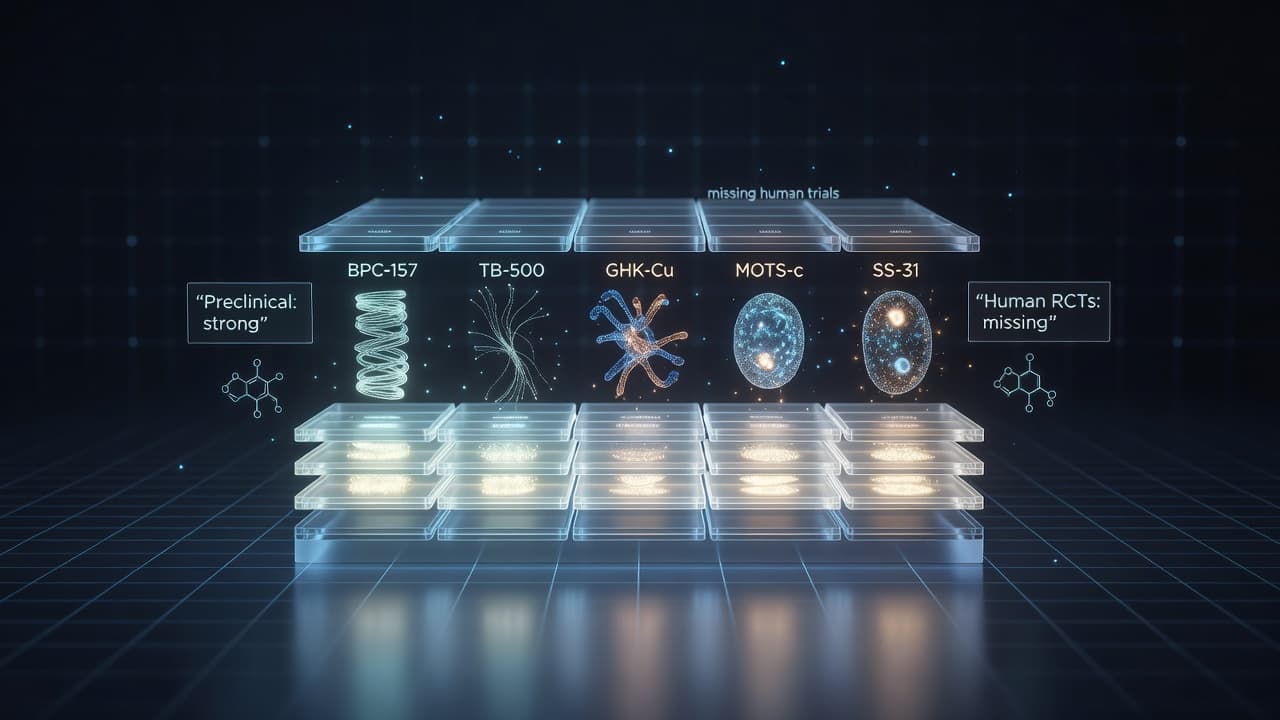
In early 2026, a comprehensive preprint was published that systematically compares the safety and efficacy data of several unapproved peptides: "Safety and Efficacy of Approved and Unapproved Peptide Therapies for Musculoskeletal Injuries and Athletic Performance." The paper comes from the sports medicine field and examines both approved and unapproved peptides through the lens of injury healing, tissue regeneration, and performance enhancement.
This article summarises the key findings and provides context for interpreting them.
Scope and Type of the Work
This is a narrative review that compares preclinical data, available human studies, safety profiles, and regulatory aspects. The authors distinguish between peptides with existing approvals (such as GH secretagogues) and those used exclusively in research (BPC-157, TB-500, GHK-Cu, MOTS-c, SS-31).
A particular strength of the paper is that it explicitly addresses the influence of social media reporting and expectation effects, an aspect that has been underrepresented in earlier reviews.
Healing Peptides: BPC-157, TB-500, and GHK-Cu
BPC-157
The review confirms the extensive preclinical evidence base for BPC-157. In animal models, accelerated healing of tendons, ligaments, muscles, and intestinal tissue has been described, mediated through mechanisms including angiogenesis, anti-inflammatory signalling, and growth factor pathways (VEGF, EGF, TGF-beta).
At the same time, the authors highlight a central limitation: large randomised controlled human trials remain absent. Furthermore, the strong VEGF stimulation is discussed as potentially problematic in the presence of existing tumours, as enhanced angiogenesis could theoretically promote tumour growth.
TB-500 (Thymosin Beta-4)
For TB-500, the review describes preclinical findings on tissue repair, particularly in muscle and skin injuries. Human data remains sparse. The authors reference individual case reports and small observational studies but emphasise that controlled clinical data is lacking.
GHK-Cu
GHK-Cu is described as a peptide with a documented role in wound healing and collagen synthesis. The review highlights topical applications as comparatively well studied, but notes the risk of copper toxicity in joints with systemic (injectable) use. This point is particularly relevant for those using GHK-Cu subcutaneously or intra-articularly.
Mitochondrial Peptides: MOTS-c and SS-31
MOTS-c
MOTS-c is described as a mitochondrially encoded peptide with exercise-mimetic properties. In animal models, effects on AMPK signalling, glucose metabolism, and insulin sensitivity have been observed. The review characterises these findings as promising but very early-stage: meaningful human studies on long-term use are practically non-existent.
SS-31 (Elamipretide)
SS-31 holds a special position in the review, as elamipretide received accelerated FDA approval for Barth syndrome in 2025. The authors discuss its mitochondria-targeted mechanism of action (cardiolipin stabilisation) and ongoing Phase 3 trials in age-related macular degeneration and heart failure. However, they stress that the approval was based on an intermediate endpoint and cannot be readily extrapolated to other indications.
Social Media, Expectation Effects, and Evidence Gaps
One of the most notable sections of the review addresses the discrepancy between online experience reports and actual clinical evidence. The authors argue that a substantial portion of positively reported experiences can be explained by contextual factors:
- Expectation effects: Knowing that one is taking an expensive "research chemical" can alter subjective perceptions.
- Community reinforcement: Positive reports receive more attention in social media groups than neutral or negative ones.
- Injection ritual: The act of injection itself can serve as a reinforcing therapeutic ritual.
This observation should not be read as a refutation of preclinical data, but rather as a reminder that individual experience reports are no substitute for controlled studies.
Regulatory Outlook
The paper mentions the possible FDA reclassification of some peptides in 2026 in positive terms, but still sees substantial regulatory hurdles for general approval of the currently unapproved substances. In particular, most of the peptides discussed lack the evidence base that regulatory agencies typically require: Phase 2/3 data from controlled human studies with clearly defined endpoints.
Limitations of the Review
As with any narrative review, there are methodological constraints:
- No systematic search protocol with predefined inclusion and exclusion criteria
- No meta-analysis of published effect sizes
- The focus is on sports medicine; other application contexts (such as gastrointestinal or neurological) are only briefly touched upon
- This is a preprint that has not yet completed peer review
Assessment
This review is among the most comprehensive summaries of available data on unapproved peptides in the sports medicine context. It stands out for its balanced tone: preclinical findings are acknowledged without being overinterpreted, and the evidence gaps in humans are clearly identified.
For researchers working with these substances, the paper provides a useful reference framework, both for the described mechanisms and for the open questions that remain.
Gastric pentadecapeptide (15 amino acids) known for exceptional tissue repair properties. Promotes wound healing, angiogenesis, and cytoprotection across tendons, muscles, gut, and nerves. Over 30 years of preclinical research.
Full-length 43-amino-acid Thymosin Beta-4, a naturally occurring repair protein, independently confirmed by a third-party CoA from Janoshik. Promotes cell migration and new blood vessel formation for systemic tissue healing. Especially researched for muscle, tendon, and cardiac repair.
The Wolverine Stack: BPC-157 + TB-500 in equal parts in one vial (50/50: 10mg = 5mg each, 20mg = 10mg each). The most researched healing peptide duo for tissue repair, tendon recovery, and systemic regeneration. Batch-specific Janoshik COA.
Naturally occurring copper tripeptide complex for skin regeneration and anti-aging research. Stimulates collagen synthesis, accelerates wound healing, and modulates 4000+ genes. Plasma levels decline with age, making it a key target in longevity research.
Mitochondrial-derived signaling peptide (16 amino acids) that mimics the effects of exercise at the cellular level. Activates AMPK, improves glucose uptake, and enhances fat metabolism - a key tool in metabolic and longevity research.
Mitochondria-targeted tetrapeptide (Elamipretide) that stabilizes cardiolipin and prevents ROS formation at the source.
Tetrapeptide (Ala-Glu-Asp-Gly) that activates telomerase, the enzyme responsible for maintaining telomere length. One of the most studied peptides in longevity research, developed by Prof. Khavinson at the St. Petersburg Institute of Bioregulation.
Reference
- "Safety and Efficacy of Approved and Unapproved Peptide Therapies for Musculoskeletal Injuries and Athletic Performance." Preprints, 2026. Preprint
Frequently Asked Questions
This article is for informational and educational purposes only. The data discussed is predominantly from preclinical studies (animal and cell models) and does not constitute evidence of efficacy in humans. Nothing in this article should be interpreted as medical advice or a recommendation for use. All products mentioned are sold exclusively for research purposes.
Research context for English-speaking buyers
Most of our English-speaking customers ship to the UK, Ireland, Malta or other English-as-second-language EU territories. The regulatory picture differs per country.
- Relevant authorities
- MHRA (UK, post-Brexit), HPRA (Ireland, EU-aligned), FDA Section 503A bulks list (US, restricted Cat 2 status of several peptides as of 2026)
- Customs and VAT
- EU shipments include 19% VAT; UK shipments after Brexit are now extra-EU and may attract UK VAT plus a handling fee at import
- Typical shipping window
- EU 2-4 working days, UK 4-7 working days, other international 7-14 working days, depending on customs
Research-grade peptides shipped from our EU warehouse are sold for laboratory use only and are not authorised for human or veterinary therapeutic application in any of the destination jurisdictions. US customers should be aware that the FDA Section 503A bulks list classification (and the April 2026 reclassification of twelve compounds) only governs compounding pharmacies, not direct-to-researcher imports for non-clinical work. UK buyers should declare the consignment on import and may be asked for a research justification by HMRC. We provide a CoA per batch identified by colour code rather than serial number; customs sometimes asks for this document when clearing the parcel.