Underdosed or a Non-Responder? What HPLC and Mass Spectrometry Can Prove, and What They Cannot
When a peptide seems not to work, two explanations compete: the vial or the person. What purity, content and identity tests settle, what they cannot, and the trial base rates.
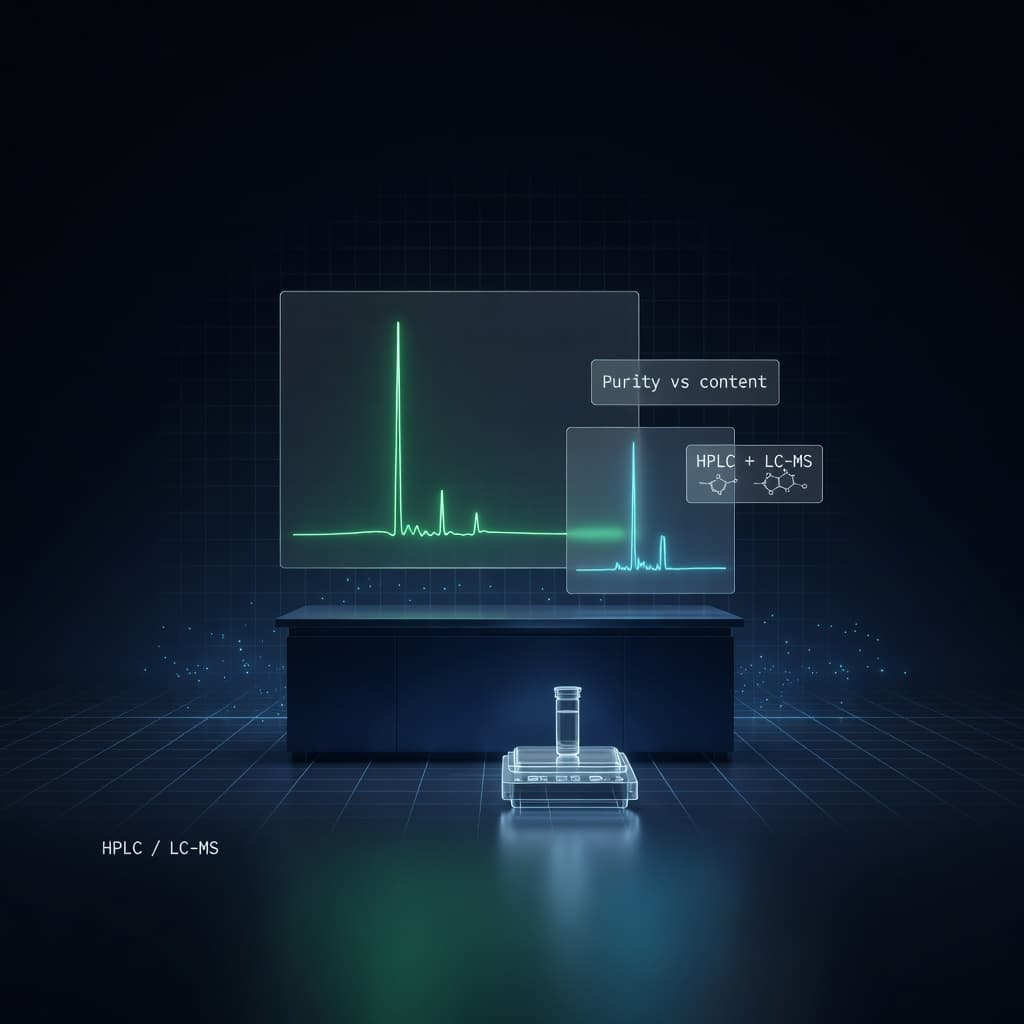
Existing articles on this site cover how to read a certificate field by field (How to read a certificate of analysis), what a CoA does not test (What a CoA does not test), our own testing layers (Certificates of analysis: independent lab testing), why BPC-157 results vary (Why BPC-157 results vary) and the EU synthetic-peptide guideline (EMA synthetic peptide guideline 2026). This article answers one recurring question instead: when a peptide seems not to work, is the vial underdosed or is the person a non-responder, and which measurement actually tells the two apart. It sets out what a purity percentage, a content figure and an identity check each prove and cannot prove, what published analyses of gray-market products found, what the trials report about non-response at labeled doses, and why appearance, feel and a friend's result are not measurements. It is purely informative: no dosing, titration or reconstitution guidance, and no next-step advice beyond describing which measurement answers which question.
TL;DR: what the measurements can and cannot settle
- Two explanations compete when a peptide seems not to work, an underdosed vial or a non-responder person, and forum posts cannot separate them: among our own 165 community posts using non-responder language, only 2 mention any test of the product itself.
- Purity is a ratio, content is a quantity, and identity is a mass match; none of the three measures biological activity. A vial can be highly pure and still hold the wrong number of milligrams, or hold the right number of milligrams and the wrong purity.
- Published analyses of gray-market products found purity as low as 7.7% to 14.4% against label claims, content above the labeled amount in the same vials, and endotoxin in every sample tested.
- In trials at labeled doses with verified product, 9% to 15% of participants did not reach 5% weight loss, and a 2026 review puts non-response at approximately 10% of trial participants overall.
- Our own 78 lab reports, read from the live CoA page on August 27, 2026, show purity between 99.0% and 99.97%, figures that describe the vials tested, not every vial, and say nothing about response.
Research use only
Retatrutide, tirzepatide, BPC-157 and every peptide named in this article are sold here as laboratory research materials, not as medicines, and not for administration to a person or animal. This article compares what purity, content and identity testing can prove against what a forum self-report can prove; it makes no claim that any product works, that any reader is a responder or non-responder, or that our own lab reports say anything about how a peptide performs in a person, and it contains no dosing, titration or reconstitution instructions.
First-ever triple-action weight management peptide targeting three receptors at once: GLP-1, GIP, and glucagon. Shown exceptional results in Phase 2 trials - up to 24% weight reduction. The most advanced metabolic peptide available.
A first-in-class dual GIP and GLP-1 receptor agonist, and one of the most extensively studied compounds in modern metabolic and weight-regulation research. Supplied as a lyophilised research peptide with a per-batch certificate of analysis, for laboratory and in-vitro use only.
Gastric pentadecapeptide (15 amino acids) known for exceptional tissue repair properties. Promotes wound healing, angiogenesis, and cytoprotection across tendons, muscles, gut, and nerves. Over 30 years of preclinical research.
GIP/GLP-1/Glucagon agonists and metabolic pathways
What the forums argue about
Our Reddit corpus, the 12 months to August 2026, is a community report, real language from real posters, not a scientific sample. Of 71,269 peptide-related posts in the period, the table below breaks out how often each relevant theme appears.
- Count
- 71,269
- Count
- 1,259
- Count
- 1,107
- Count
- 852
- Count
- 165
- Count
- 116
- Count
- 61
- Count
- 133
Of those 133 posts, 72 concern retatrutide, 31 tirzepatide, 14 semaglutide, 6 BPC-157, 5 NAD+ and 4 MOTS-c. Among the 852 testing posts, r/Retatrutide accounts for 393, r/Biohackers for 170, r/Peptides for 148 and r/PeptideDiscussion for 96.
Within the 1,259 not-working posts, 558 mention appetite or food noise, 150 blame a vendor, batch, source or a bunk product, 135 are written within the first four weeks, and 120 mention the scale not moving. Within the 165 non-responder posts, 56 give a duration on the compound and 34 mention a dose increase, but only 2 of the 165 mention any test of the product itself. Within the 852 testing posts, 260 name Janoshik, 190 mention purity, 99 mention endotoxin or sterility, only 13 mention quantity or milligrams per vial, and 6 ask whether a certificate can be faked.
A handful of threads illustrate the pattern, cited by title only, with no links or usernames. "Don't listen to people who say it is your fault if it is not working..." (41 upvotes, 110 comments) allows exactly two explanations, a low responder or a fake product, and quotes the retatrutide phase 2 trial's finding that 25%, 9% and 7% of participants did not reach 10% weight loss at the 4, 8 and 12 mg doses. "Non-responder and sad" (108 upvotes, 145 comments) describes eight months on tirzepatide without weight loss while a friend lost over 100 lb. "No, It's Not Water" (202 upvotes, 76 comments) describes a poster whose appetite returned after an infection and a dose change, on the same vial that had worked for months, attributing the change to the body rather than the vial, while "Do you eventually become immune to the magic of tirz?" (46 upvotes, 170 comments) raises the same question without resolving it. "Paper tested grey market semaglutide, purity was 7.7-14.4% vs. the claimed 99%" (185 upvotes, 103 comments) links the 2024 published analysis discussed next, and "Am I overthinking peptide safety, or are these concerns valid?" (3 upvotes, 68 comments) lists purity, endotoxin, residual solvents, heavy metals and substituted product as open questions. "Underdosing?" (1 upvote, 14 comments) turns out to be a volume-arithmetic question, a vial still half full after three weeks, not a product question. "Difference in lyophilized peptide cakes between batches?" (7 upvotes) describes people judging dose by the size or fluffiness of the freeze-dried cake, and "Janoshik Analytical, a Review" (16 upvotes, 29 comments) discusses the testing laboratory itself. A video titled "MUST WATCH: Peter Magic (Janoshik Founder) Drops BOMBSHELLS in PepTok Interview" (139 upvotes, 34 comments) circulated as a thread; its content, like all YouTube and TikTok material, was not reviewed for this article.
The pattern across these threads holds: the two explanations are argued from feel, timing and comparison with other people, and in the non-responder posts almost nobody reports a measurement of the vial itself.
Three measurements, three different questions
As an analytical principle, HPLC-UV purity is a ratio: the area of the main peak divided by the total area of all peaks in the chromatogram, which is the fraction of the UV-absorbing material that is the target peptide. It says nothing about how many milligrams are in the vial. Our own field-by-field CoA article puts the distinction directly: "99.154% is a ratio; 10.73 mg is a quantity" (How to read a certificate of analysis).
Reading a chromatogram follows the same analytical principle throughout the field: the x-axis is retention time, the y-axis is detector response, the main peak is the target peptide, and smaller peaks before or after it are impurities or degradation products; a shoulder on the main peak, a partial bump rather than a fully separated peak, can hide a co-eluting impurity. A published methods review (Sharma et al. 2022) describes RP-HPLC-UV combined with high-resolution mass spectrometry, size-exclusion and ion-exchange chromatography as the standard toolkit for characterizing impurities, degradation products and aggregation in synthetic peptides.
Content, the number of milligrams in a vial, is a separate measurement from purity. It requires a reference standard of known concentration and a calibration curve; without a reference standard, a laboratory can identify what a substance is but cannot state how much of it is present. One published analysis of black-market pharmaceuticals reported that "quantitation could not be carried out because of the lack of reference standards" for 12 of 75 products tested, an identity result without a quantity result.
Identity is a third, distinct measurement. LC-MS matches the measured molecular mass of the material to the expected mass of the labeled sequence, and MS/MS fragmentation confirms the sequence itself. The same LC-MS run can also quantify oxidation, deamidation and chain cleavage as the ratio of modified to unmodified peptide peak areas; a published analysis of recombinant growth hormone (Jiang et al. 2009) found methionine oxidation at three distinct positions, deamidation at a fourth, and chain cleavages that differed between the innovator, counterfeit and follow-on products tested. A published review of falsified biotherapeutics (Janvier et al. 2018) notes that a combination of electrophoretic, immunological and mass-spectrometric approaches is often needed "to merely identify the content of seized samples," let alone quantify or fully characterize it.
The EU guideline on synthetic peptides (European Medicines Agency 2025) sets three thresholds for impurities: a reporting threshold of 0.1%, an identification threshold of 0.5% above which an impurity should be identified rather than only counted, and a qualification threshold of 1.0% for co-eluting impurities observed as a single peak. The guideline further states that "for comparability purposes a full evaluation of the peptide-related impurity profile at levels 0.1-0.5% is expected." Typical synthetic-peptide impurities and degradation products include deletion or truncated sequences, oxidation, deamidation and aggregation.
- What it proves
- Fraction of the UV-absorbing material that is the target peptide
- What it cannot prove
- Milligrams in the vial; biological activity
- What it proves
- Quantity of target peptide against a reference standard
- What it cannot prove
- Purity; biological activity
- What it proves
- Molecular mass matches the expected sequence; oxidation, deamidation and cleavage ratios
- What it cannot prove
- Quantity; biological activity; endotoxin or sterility
What none of them proves
None of these three measurements, on their own or together, proves biological activity: no bioassay is involved in a purity, content or identity result. None of them is an endotoxin test, a separate LAL assay; one published analysis found endotoxin in every sample tested despite finding no viable microorganisms in any of them. None of them is a sterility, heavy-metals or residual-solvents test either, each requiring its own separate method (see What a CoA does not test), and none says anything about what happens inside a person who uses the material.
Purity and content are also independent, not two views of the same fact: the same published gray-market analysis found content above the labeled amount together with purity far below the labeled claim, in the same vials. A vial can fail on one axis while passing on the other.
Some things a poster describes are simply not measurements at all. The size or texture of a lyophilized cake changes with fill volume, formulation, the freeze-drying cycle and vial geometry, not with the milligrams inside. How strong an effect feels in the first week is not a measurement. And another person's result, on a different vial from a different source with a different history, is not a measurement of the vial in front of the person asking the question.
What published analyses of gray-market products found
Three published analyses, cited in full below, examined products or safety reports associated with gray-market and counterfeit supply rather than forum reports, and a fourth pharmacovigilance study covered compounded pharmacy products, a different supply chain; together they describe a supply chain where purity, content, endotoxin and delivery can each fail independently.
- Sample and method
- 3 delivered semaglutide vials, online sellers, no prescription
- Key finding
- Purity 7.7% to 14.37% vs 99% label; content exceeding the labeled amount by 28.56% to 38.69%; endotoxin in all samples
- Sample and method
- EudraVigilance 2018-2025, 234 reports related to potential counterfeit semaglutide
- Key finding
- 89.3% of suspected reactions serious; disproportionate "drug ineffective," hypoglycemia, off-label use
- Sample and method
- 75 seized pharmaceuticals, 35 supplements, French bodybuilders
- Key finding
- 33% substandard, 32% counterfeit, 19% original; 12 products could not be quantified at all
- Sample and method
- FAERS 2018-2024, 707 compounded GLP-1 RA reports
- Key finding
- Higher reporting odds for contamination (ROR 19.00, 95% CI 4.24 to 85.03), compounding or manufacturing issues (8.51, 5.17 to 14.0), preparation errors (48.92, 12.63 to 189.6) and hospitalization (2.35, 1.94 to 2.83)
The 2024 published analysis (Ashraf and colleagues, J Med Internet Res, PMID 39509151) bought semaglutide from online sellers without a prescription. The vials delivered were "considered probable substandard and falsified products," failing 59% to 63% of the visual criteria applied, with purity and content diverging in opposite directions, "although no peptide-like impurities were identified." No viable microorganisms were found, but endotoxin was present in every sample, at 2.1645 to 8.9511 EU/mg. None of the three prefilled pens ordered separately ever arrived, a non-delivery outcome rather than a product-quality one.
The 2026 published analysis of EudraVigilance reports (Zinzi and colleagues, Front Pharmacol, PMID 42137313) covers 2018 to 2025 and identifies 234 case safety reports linked to potential counterfeit semaglutide, with 89.3% of the suspected adverse reactions rated serious, with terms including hypoglycemia, product use in an unapproved indication, malaise and drug ineffective reported disproportionately more often than in non-counterfeit semaglutide reports. This is a pharmacovigilance reporting-pattern signal, not a laboratory test of a specific vial.
The 2021 published analysis of black-market seizures (Fabresse and colleagues, Forensic Sci Int, PMID 33838562) examined 75 pharmaceuticals and 35 supplements seized from bodybuilders in France; 43 of 54 anabolic steroids tested were non-original. Twelve products with correct qualitative content could not be quantified at all, for lack of reference standards, an identity result with no quantity result, the same gap described in the previous section.
A 2026 published analysis of FAERS reports (McCall and colleagues, Expert Opin Drug Saf, PMID 40285721), covering 2018 to 2024, found that 707 of 81,078 GLP-1 receptor agonist reports involved compounded products, with substantially higher reporting odds for contamination, compounding or manufacturing issues, preparation errors and hospitalization (exact ratios in the table above). Compounded pharmacy products sit in a different supply chain from gray-market research vials; this study is cited for its product-quality signal category, not as a gray-market finding itself.
Non-response at labeled doses: the base rates
The trials below all used a product at a labeled or protocol dose, with verified identity and content, so the share of participants who did not reach a given weight-loss threshold defines a base rate for non-response when the vial itself is not in question.
- Regimen and duration
- Semaglutide 2.4 mg weekly, 68 weeks
- n
- 1,961
- Reached 5% or more (share that did not)
- 86.4% vs 31.5% placebo (13.6% did not)
- Regimen and duration
- Tirzepatide 5, 10 or 15 mg weekly, 72 weeks
- n
- 2,539
- Reached 5% or more (share that did not)
- 85%, 89% and 91% at 5, 10 and 15 mg vs 35% placebo (9% to 15% did not)
- Regimen and duration
- Retatrutide 4, 8 or 12 mg weekly, 48 weeks
- n
- Trial population
- Reached 5% or more (share that did not)
- 92%, 100% and 100% at 4, 8 and 12 mg vs 27% placebo
In STEP 1 (Wilding and colleagues, N Engl J Med 2021, PMID 33567185), 1,961 adults without diabetes on semaglutide 2.4 mg weekly for 68 weeks reached 5% or more weight loss in 86.4% of cases against 31.5% on placebo, mean change -15.3 kg against -2.6 kg: 13.6% of the active-dose group stayed below 5% at 68 weeks. In SURMOUNT-1 (Jastreboff and colleagues, N Engl J Med 2022, PMID 35658024), 2,539 adults on tirzepatide 5, 10 or 15 mg weekly for 72 weeks reached 5% or more in 85%, 89% and 91% of cases against 35% on placebo, mean change -20.9% at 15 mg against -3.1%: 9% to 15% stayed below 5% across the three doses. In the retatrutide phase 2 trial (Jastreboff and colleagues, N Engl J Med 2023, PMID 37366315), 48 weeks, 5% or more was reached in 92%, 100% and 100% of cases at the 4, 8 and 12 mg doses against 27% on placebo, mean change -24.2% at 12 mg against -2.1% on placebo; 10% or more was reached in 75%, 91% and 93% against 9%, and 15% or more in 60%, 75% and 83% against 2%.
A 2026 narrative review (Kuryłowicz and Czupryniak, Diabetes Obes Metab, PMID 42634284) puts these trial figures in context: non-response, commonly defined as less than 5% total body weight loss, affects approximately 10% of participants in controlled trials in obesity without diabetes, with real-world cohorts suggesting a higher frequency in routine practice. The review states that early on-treatment response is the most readily actionable predictor currently available, that no single baseline characteristic reliably predicts response, and that genetic, metabolic and microbiome markers require prospective replication before clinical application.
A 2026 genome-wide association study (Su and colleagues, Nature, PMID 41951734) of 27,885 people with self-reported weight loss on GLP-1 receptor agonist therapy found a missense variant in the GLP1R gene associated with greater efficacy (P = 2.9 x 10^-10), an additional -0.76 kg per copy of the effect allele; separate GLP1R and GIPR variants were associated with nausea or vomiting, the GIPR association restricted to tirzepatide users. Self-reported and drawn from a single cohort, this is exactly the kind of finding the review above calls hypothesis-generating rather than ready for clinical application.
A 2018 real-world study of liraglutide in type 2 diabetes (Gomez-Peralta and colleagues, Diabet Med, PMID 29943854) found that longer treatment predicted a better HbA1c and weight response, a higher baseline weight predicted a better weight response, and a higher baseline HbA1c, a longer diabetes duration and insulin use predicted a worse glycemic response: response correlates with measurable baseline and treatment-course factors even where the product itself is not in question.
A gray-market vial removes that certainty, which is exactly why the two explanations, underdosed and non-responder, cannot be separated by outcome alone.
Our own reports, read the same way
Our own lab-report data belongs in the same framework, read the same way as everything above: as a measurement of specific vials on a specific date, not as evidence about response. Read from the live CoA page on August 27, 2026, the page lists 78 reports for 32 products, all issued by the same testing laboratory: 51 commissioned by the manufacturer, 24 submitted by community members, and 3 commissioned independently. Of the 78, 73 carry a purity figure, ranging from 99.0% to 99.97% with a median of 99.55%, and 77 carry a content figure in milligrams.
Our nine retatrutide reports illustrate the content side specifically: measured content ranges from 14.82 mg on a 15 mg label to 56.06 mg on a 50 mg label, which is 98.8% to 112% of the labeled amount, with purity between 99.5% and 99.95% across the same nine reports. Endotoxin figures appear on 4 of the 78 reports, heavy-metal results on 27, and microbial results on 28.
These figures describe the vials that were tested, on the dates they were tested; they do not describe every vial we have shipped, and, in line with everything above, they say nothing about how any vial performs in a person. The figures will change as further reports are added to the page.
Underdosed or non-responder: the decision logic
Together, the measurements above and the trial base rates answer two different questions, exactly the ones confused in the forum threads described earlier.
- Which measurement answers it
- Content assay (mg by HPLC vs a reference standard) plus identity check (LC-MS)
- What does not answer it
- Purity alone; cake size; color; how it feels
- Which measurement answers it
- Comparison with trial response distributions once the vial question is closed
- What does not answer it
- A single forum comparison; timing alone; another person's result
"Underdosed" is a claim about the vial. It is answered by a content assay of that specific vial, milligrams measured by HPLC against a reference standard, together with an identity check by LC-MS confirming the material is the labeled peptide rather than something else entirely. Purity alone does not answer it: a 99% pure vial can hold 5 mg or 15 mg, since purity is a ratio and content is a quantity. Neither does the size of the lyophilized cake, its color, or how an effect feels.
"Non-responder" is a claim about the person, and it can only be answered once the vial question is closed. It is answered by comparing the individual's time course with the trial response distributions described above, which show 9% to 15% of participants on verified product below the 5% threshold at 48 to 72 weeks, together with the review's point that early on-treatment response is the most readily actionable predictor currently available.
A third class of explanation is neither about the vial nor the person in the sense above: reconstitution and volume arithmetic, the subject of the "Underdosing?" thread cited earlier, is a math question, not a product question; storage-related degradation shows up in a chromatogram as additional peaks, the same analytical principle described above, not as an empty vial; and expectation, formed by reading the same threads before or during use, is a property of neither the vial nor the person's biology.
What a forum comparison cannot do
None of the measurements above are available inside a Reddit thread, which is exactly what makes a forum comparison unable to answer either question. Two people on different vials from different sources, with different adherence and baselines, cannot be meaningfully compared; the trial base rates above are the only comparator with a verified product behind the numbers.
Time course varies inside the corpus itself, and without a shared starting point a comparison between two accounts measures nothing: our own time-course article describes when retatrutide's other effects are typically reported to appear in trial data, and a forum report from the first weeks is not a comparable input to one written months later, or to a trial's fixed follow-up point. Product identity, similarly, cannot be verified from a forum post; identity requires an LC-MS measurement of the vial itself (our buying guide covers certificate verification).
The forums support this reading of themselves: of the 165 posts using non-responder language, only 2 mention any test of the product, and of the 1,259 not-working posts, 150 default to blaming a vendor, batch or source without a measurement to back it. Feel, timing and comparison with other people are what forum posts offer; a content assay, an identity check and a trial response distribution are what actually distinguish the two explanations.
Where these products sit in our catalog
The measurement principles above apply to research peptides generally; the products below are the ones most discussed in the community threads cited in this article.
Triple agonist, GLP-1-class research
For the field-by-field breakdown of a certificate, see our how to read a CoA article. For what a CoA does not test, see what a CoA does not test. For our independent testing layers, see certificates of analysis: independent lab testing. For the EU guideline behind the impurity thresholds used above, see our guideline article. Current lab reports for every product are on the CoA page.
Frequently asked questions
Sources
- Sharma N, Kukreja D, et al. Synthetic pharmaceutical peptides characterization by chromatography principles and method development. J Sep Sci. 2022;45:2200-2216. PMID 35460196. https://pubmed.ncbi.nlm.nih.gov/35460196/
- Jiang H, Wu SL, et al. Mass spectrometric analysis of innovator, counterfeit, and follow-on recombinant human growth hormone. Biotechnol Prog. 2009;25:207-18. PMID 19224592. https://pubmed.ncbi.nlm.nih.gov/19224592/
- Janvier S, De Spiegeleer B, et al. Falsification of biotechnology drugs: current dangers and/or future disasters? J Pharm Biomed Anal. 2018;161:175-191. PMID 30165334. https://pubmed.ncbi.nlm.nih.gov/30165334/
- European Medicines Agency. Guideline on the development and manufacture of synthetic peptides, EMA/CHMP/CVMP/QWP/367182/2025, published 9 December 2025, effective 1 June 2026. https://www.ema.europa.eu/en/development-manufacture-synthetic-peptides-scientific-guideline
- Ashraf AR, Mackey TK, et al. Multifactor Quality and Safety Analysis of Semaglutide Products Sold by Online Sellers Without a Prescription: Market Surveillance, Content Analysis, and Product Purchase Evaluation Study. J Med Internet Res. 2024;26:e65440. PMID 39509151. https://pubmed.ncbi.nlm.nih.gov/39509151/
- Zinzi A, Gaio M, et al. Unmasking counterfeit semaglutide: analysis of real-world safety data from EudraVigilance. Front Pharmacol. 2026;17:1805842. PMID 42137313. https://pubmed.ncbi.nlm.nih.gov/42137313/
- Fabresse N, Gheddar L, et al. Analysis of pharmaceutical products and dietary supplements seized from the black market among bodybuilders. Forensic Sci Int. 2021;322:110771. PMID 33838562. https://pubmed.ncbi.nlm.nih.gov/33838562/
- McCall KL, Mastro Dwyer KA, et al. Safety analysis of compounded GLP-1 receptor agonists: a pharmacovigilance study using the FDA adverse event reporting system. Expert Opin Drug Saf. 2026;25:581-588. PMID 40285721. https://pubmed.ncbi.nlm.nih.gov/40285721/
- Wilding JPH, Batterham RL, et al. Once-Weekly Semaglutide in Adults with Overweight or Obesity. N Engl J Med. 2021;384:989-1002. PMID 33567185. https://pubmed.ncbi.nlm.nih.gov/33567185/
- Jastreboff AM, Aronne LJ, et al. Tirzepatide Once Weekly for the Treatment of Obesity. N Engl J Med. 2022;387:205-216. PMID 35658024. https://pubmed.ncbi.nlm.nih.gov/35658024/
- Jastreboff AM, Kaplan LM, et al. Triple-Hormone-Receptor Agonist Retatrutide for Obesity - A Phase 2 Trial. N Engl J Med. 2023;389:514-526. PMID 37366315. https://pubmed.ncbi.nlm.nih.gov/37366315/
- Kuryłowicz A, Czupryniak L. Responders Vs. Non-Responders or How to Predict the Response to GLP-1 or GLP-1/GIP Receptor Agonist Therapy. Diabetes Obes Metab. 2026. PMID 42634284. https://pubmed.ncbi.nlm.nih.gov/42634284/
- Su QJ, Ashenhurst JR, et al. Genetic predictors of GLP1 receptor agonist weight loss and side effects. Nature. 2026;653:770-775. PMID 41951734. https://pubmed.ncbi.nlm.nih.gov/41951734/
- Gomez-Peralta F, Lecube A, et al. Interindividual differences in the clinical effectiveness of liraglutide in Type 2 diabetes: a real-world retrospective study conducted in Spain. Diabet Med. 2018;35:1605-1612. PMID 29943854. https://pubmed.ncbi.nlm.nih.gov/29943854/
- PeptidesDirect lab-report page, read 27 August 2026: 78 reports for 32 products; purity range, content figures and report sources as stated in the article. /coa
- Reddit corpus extraction, 12 months to August 2026 (our own count: 71,269 peptide-related posts; cluster counts as stated); threads cited by title, not linked; YouTube and TikTok content not reviewed.
Research use only. Retatrutide, tirzepatide, BPC-157 and every other peptide named in this article are supplied for laboratory research, not for human or animal administration, and not as medicines. Nothing in this article is dosing, titration or reconstitution guidance, and nothing here claims that any product works, that any reader is a responder or a non-responder, or that our own lab report figures describe anything beyond the specific vials tested.
Research context for English-speaking buyers
Most of our English-speaking customers ship to the UK, Ireland, Malta or other English-as-second-language EU territories. The regulatory picture differs per country.
- Relevant authorities
- MHRA (UK, post-Brexit), HPRA (Ireland, EU-aligned), FDA Section 503A bulks list (US, restricted Cat 2 status of several peptides as of 2026)
- Customs and VAT
- EU shipments include 19% VAT; UK shipments after Brexit are now extra-EU and may attract UK VAT plus a handling fee at import
- Typical shipping window
- EU 2-4 working days, UK 4-7 working days, other international 7-14 working days, depending on customs
Research-grade peptides shipped from our EU warehouse are sold for laboratory use only and are not authorised for human or veterinary therapeutic application in any of the destination jurisdictions. US customers should be aware that the FDA Section 503A bulks list classification (and the April 2026 reclassification of twelve compounds) only governs compounding pharmacies, not direct-to-researcher imports for non-clinical work. UK buyers should declare the consignment on import and may be asked for a research justification by HMRC. We provide a CoA per batch identified by colour code rather than serial number; customs sometimes asks for this document when clearing the parcel.