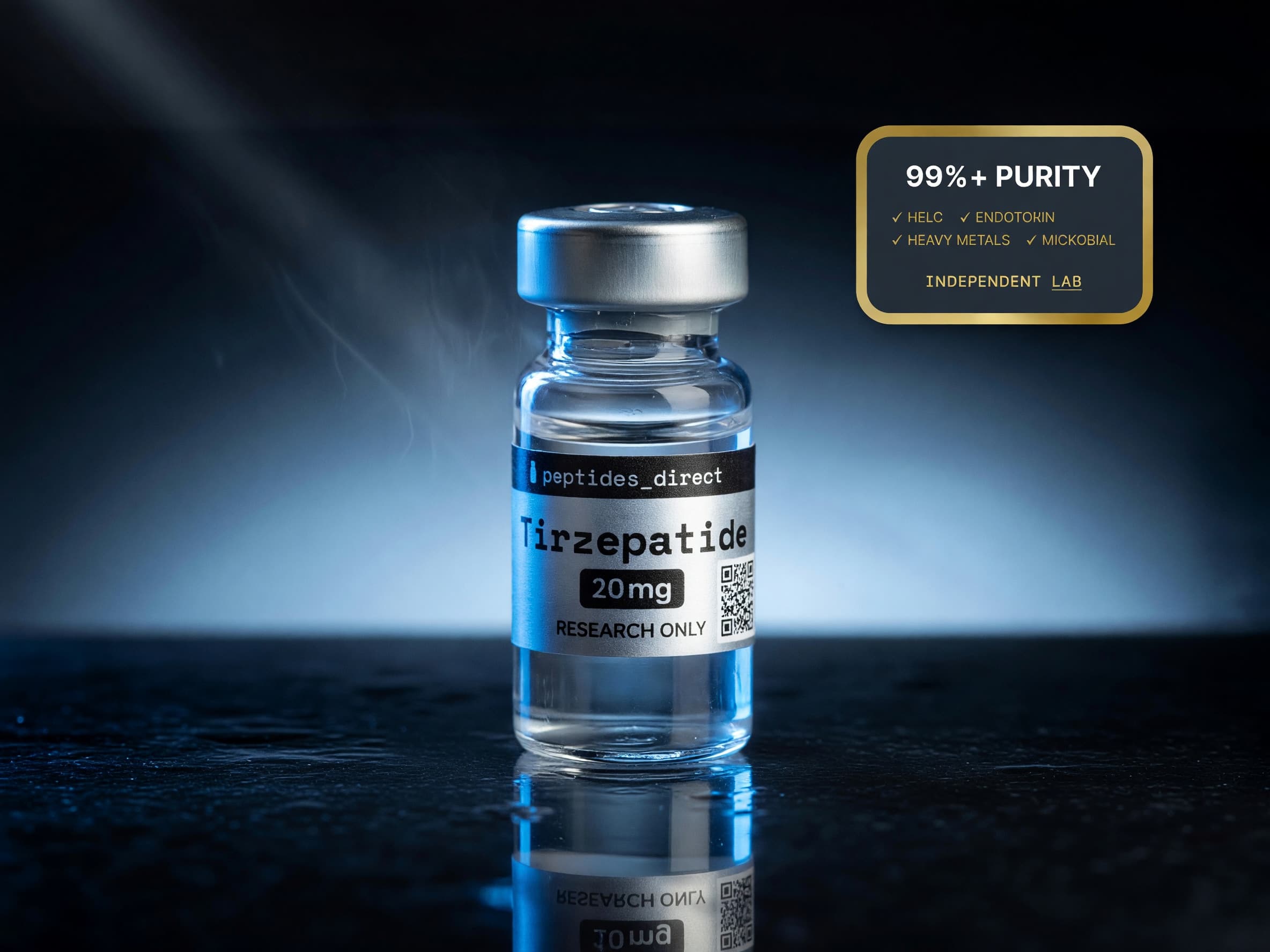
Tirzepatide
A first-in-class dual GIP and GLP-1 receptor agonist, and one of the most extensively studied compounds in modern metabolic and weight-regulation research. Supplied as a lyophilised research peptide with a per-batch certificate of analysis, for laboratory and in-vitro use only.
99.94%Third-party lab: JanoshikView COA€133.99
€148.99
−10%(€15.00)savedFor Research Use Only
This product is sold strictly for in-vitro research and laboratory use. Not intended for human consumption or any in-vivo application.
Payment Methods
Dual incretin agonist
Tirzepatide activates two metabolic receptors at once: GIP and GLP-1. It was the first single molecule to combine both incretin pathways, the step between single-agonist peptides and the newer triple agonists.
SURMOUNT obesity program
In SURMOUNT-1, the 72-week Phase 3 obesity trial, the highest dose group lost about 20.9 percent of body weight, one of the largest reductions reported for an incretin peptide at the time.
Outperformed semaglutide on glucose
Across the SURPASS Phase 3 diabetes program, tirzepatide produced larger HbA1c and weight reductions than a single-agonist comparator, beating once-weekly semaglutide head-to-head in SURPASS-2.
Liver research (MASH)
In SYNERGY-NASH, tirzepatide led to resolution of metabolic dysfunction-associated steatohepatitis without worsening fibrosis in a large share of participants, tying the GIP and GLP-1 mechanism to liver-fat research.
Beyond weight: sleep apnea and maintenance
SURMOUNT-OSA reported reduced obstructive sleep apnea severity, and SURMOUNT-4 showed that continued dosing maintained the weight reduction, with regain after withdrawal.
Between semaglutide and retatrutide
On the incretin ladder tirzepatide sits between single-agonist semaglutide and the triple agonist retatrutide, a common reference point in head-to-head trial reviews.
Research areas
What is Tirzepatide
Tirzepatide, also known by the code LY3298176, is a synthetic 39-amino-acid peptide developed by Eli Lilly. It belongs to the incretin family, the same family as semaglutide, but it was the first to target two receptors in a single molecule: GIP and GLP-1. A C20 fatty diacid chain extends its half-life to about five days, which is why research protocols use once-weekly dosing. Its Phase 3 SURPASS (diabetes) and SURMOUNT (obesity) programs are complete and have read out.
We supply it as a lyophilized (freeze-dried) powder for laboratory research, with a batch-specific third-party certificate of analysis.
How it works
Tirzepatide activates two incretin receptors at the same time:
- GLP-1 receptor: slows stomach emptying and signals fullness
- GIP receptor: improves how cells respond to insulin and shifts how lipids are stored and processed
Single-agonist peptides like semaglutide hit only the GLP-1 receptor. Tirzepatide adds the GIP arm, and the two signals together drive larger reductions in appetite, blood glucose, and body weight than a GLP-1 agonist alone. Adding a third receptor, glucagon, is what defines the next step, the triple agonist retatrutide.
Often studied alongside
Combined-peptide research often compares tirzepatide with the triple agonist retatrutide, or pairs it with the amylin analog cagrilintide, which is studied for appetite regulation. Both are available in research-grade form below.
Triple GIP/GLP-1/glucagon agonist studied for larger weight reduction
First-ever triple-action weight management peptide targeting three receptors at once: GLP-1, GIP, and glucagon. Shown exceptional results in Phase 2 trials - up to 24% weight reduction. The most advanced metabolic peptide available.
Amylin analog studied for appetite regulation
Long-acting amylin analog studied for once-weekly satiety and appetite control. Phase 3 REDEFINE trials complete, NDA filed with FDA December 2025. A mechanism distinct from GLP-1 agonists.
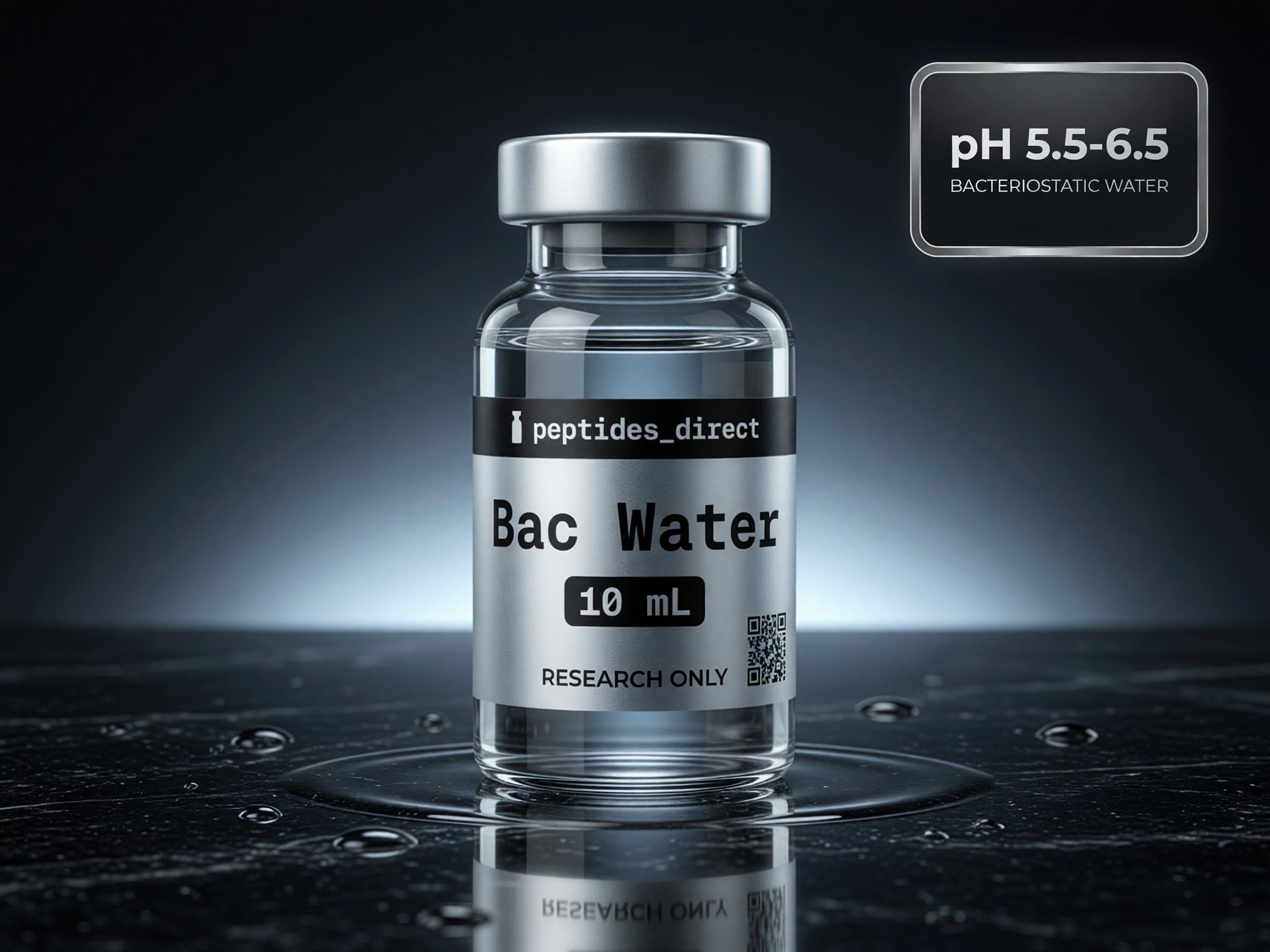
For reconstitution, the standard solvent in published protocols is bacteriostatic or sterile water.
Standard solvent for reconstitution
USP-grade sterile water with 0.9% benzyl alcohol (near-neutral, pH 6.2 to 6.4) - the standard solvent for reconstituting lyophilized peptides. Essential accessory for any peptide research. Each vial is sealed and ready to use.
Documentation
Material specification
Purity
Test method
Form
Storage (sealed)
Storage (reconstituted)
CoA
Selected research
- PMID 35658024
Jastreboff AM et al. Tirzepatide Once Weekly for the Treatment of Obesity (SURMOUNT-1)
N Engl J Med, 2022, 72-week obesity trial reporting about 20.9% weight reduction at the top dose - PMID 34170647
Frias JP et al. Tirzepatide versus Semaglutide Once Weekly in Patients with Type 2 Diabetes (SURPASS-2)
N Engl J Med, 2021, head-to-head trial versus semaglutide - PMID 34186022
Rosenstock J et al. Efficacy and safety of tirzepatide, a dual GIP and GLP-1 receptor agonist (SURPASS-1)
Lancet, 2021, Phase 3 monotherapy trial in type 2 diabetes - PMID 37385275
Garvey WT et al. Tirzepatide once weekly for obesity in people with type 2 diabetes (SURMOUNT-2)
Lancet, 2023, Phase 3 obesity trial in type 2 diabetes - PMID 38856224
Loomba R et al. Tirzepatide for Metabolic Dysfunction-Associated Steatohepatitis with Liver Fibrosis (SYNERGY-NASH)
N Engl J Med, 2024, Phase 2 MASH trial - PMID 38912654
Malhotra A et al. Tirzepatide for the Treatment of Obstructive Sleep Apnea and Obesity (SURMOUNT-OSA)
N Engl J Med, 2024, Phase 3 sleep apnea trials - PMID 38078870
Aronne LJ et al. Continued Treatment With Tirzepatide for Maintenance of Weight Reduction (SURMOUNT-4)
JAMA, 2024, randomized withdrawal and maintenance trial
Research use only
This material is sold strictly for in-vitro research and laboratory use. Not intended for human or animal consumption, medical, cosmetic, or household applications. Suitable only for professional laboratory environments.
Reconstitution: sensitive peptide
Some peptides react sensitively to the pH and quality of the reconstitution water and can turn cloudy or not fully dissolve if reconstituted incorrectly (for example with tap water, non-sterile water, old or contaminated bacteriostatic water, or the wrong water-to-peptide ratio). This is a common reconstitution matter, not an automatic sign of a faulty vial. Always reconstitute with fresh, pharmaceutical-grade diluent as prescribed by the product-specific protocol on this page (bacteriostatic or sterile water, or dilute acetic-acid water first where the page says so), add it slowly down the inner wall of the vial, and swirl gently instead of shaking. If it still looks cloudy right after mixing, let it rest for 10 to 15 minutes and swirl again before judging clarity. Correct technique and suitable water are the customer's responsibility, and so is following the product-specific instructions on this page. Where a peptide needs an acid-first protocol (it says so above, for example for AOD-9604 and Tesamorelin), reconstituting it in plain bacteriostatic water instead is a handling error, not a defect, and is not covered. If a vial stays cloudy after these steps, contact us with clear photos. We replace it free of charge once if you reconstituted with water from our own range or with factory-sealed water from a pharmaceutical manufacturer and followed the instructions on this page; with water of unknown origin the cause cannot be narrowed down and the case is not covered. Expert peptides (marked as such above) are excluded from this programme.
Best reconstituted in near-neutral bacteriostatic water (around pH 5.7, the USP water value). We recommend checking your water's pH with a cheap meter first: each peptide has its own ideal range, and matching the water is your responsibility.
Reconstitution itself, including the choice of diluent, volumes and technique, is part of the research work and lies with the customer; how a mix behaves once liquid meets powder is outside our control. Your statutory rights regarding genuine product defects remain unaffected.
Why peptides turn cloudy: the reconstitution guideStorage and stability
- Dry, lyophilized vials keep for months refrigerated, or up to 24 months frozen at -20°C.
- After reconstitution in bacteriostatic water, use within about 30 days at 2 to 8°C, and avoid repeated freeze-thaw.
Reviews
No reviews yet. Write the first one!
Only customers who ordered the product from us can leave a review; we verify this automatically against the order number. Every review submitted is published, regardless of star rating. Rewarded reviews from our coupon program are individually labelled.
Frequently Asked Questions
Technical data sheet
- CAS number
- 2023788-19-2
- Molecular formula
- C₂₂₅H₃₄₈N₄₈O₆₈
- Molar mass
- 4813.5 g/mol
- Type / receptor
- GIP / GLP-1 dual agonist
- Form
- White lyophilized powder
- Solubility
- Bacteriostatic water (BAC)
- Storage
- -20°C for up to 24 months; 30 days at 2-8°C after reconstitution
Identity data from public chemical references (PubChem). Per-batch purity: see lab reports below.
Frequently bought together
Complete your subcutaneous research workflow