Why Does My Peptide Turn Cloudy? Reconstitution, pH and Troubleshooting
Cloudiness after reconstitution is usually not a defect. Causes (pH, isoelectric point, concentration, technique), which peptides are sensitive, and a step-by-step troubleshooting guide.
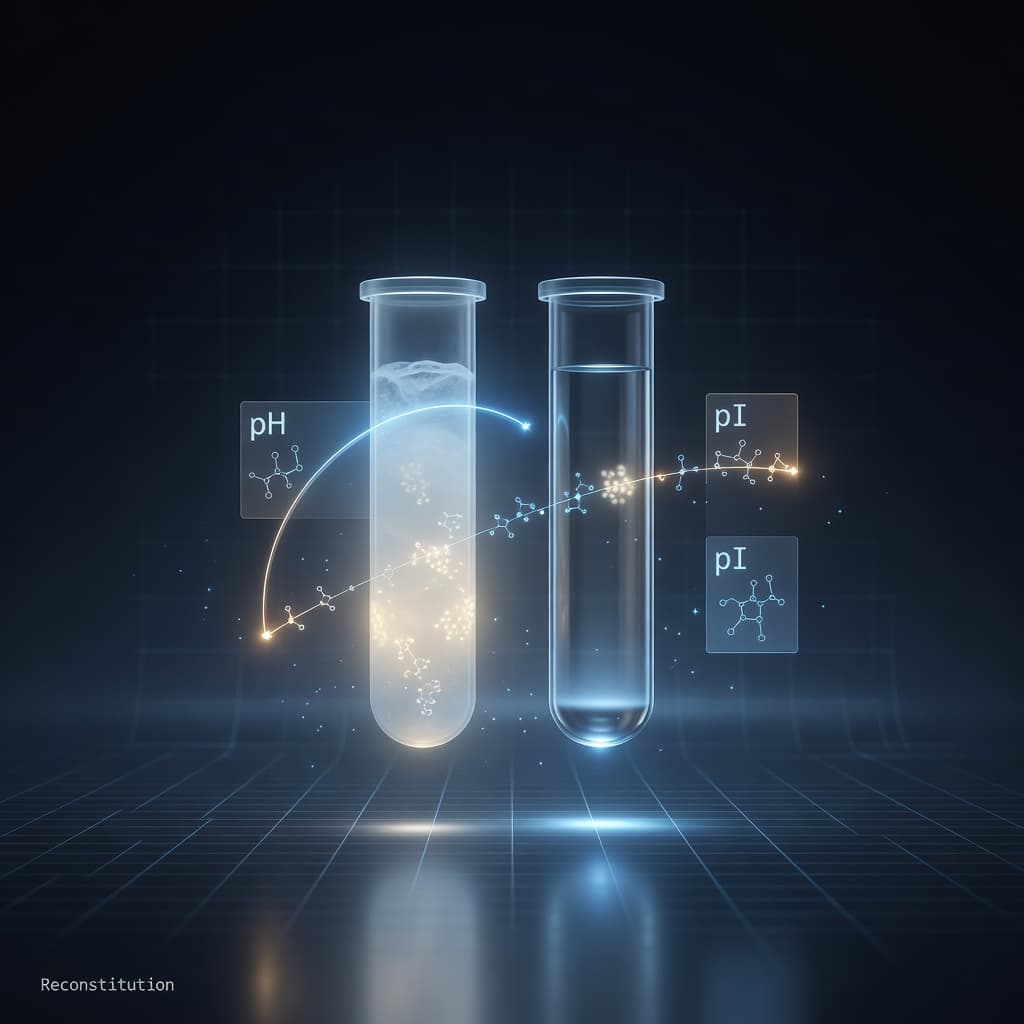
TL;DR: cloudiness is usually not a defect
Key point: A slight haze right after reconstitution is normal for many peptides and often clears on its own. Most common causes: concentration too high, rough handling (shaking, cold shock), water pH close to the peptide's isoelectric point, not the batch. The test: let it sit upright and cool for 15 to 20 minutes, swirl gently, check against a white background. Clear, colorless and particle-free means it is usable. Replacement only for real warning signs: haze that persists after resting, solid flakes or strands, or discoloration (yellow, pink, amber). Copper peptides: GHK-Cu, KLOW and GLOW are naturally blue to blue-green. That color is normal, not a flaw.
Few questions reach our support team as often as this one: the powder looked fine, the water went in, and suddenly the solution is milky instead of crystal clear. The first thought is understandable: the product must be defective. In the vast majority of cases, that is not true. Cloudiness is primarily a physical phenomenon of dissolving, not proof of a bad batch. This article explains why peptides turn cloudy, which of our products are more prone to it, how to reconstitute cleanly, and when cloudiness is actually a warning sign. It is written strictly for laboratory and educational purposes and is not usage instruction.
How reconstitution works and which water to use
Research peptides ship as a lyophilized (freeze-dried) powder, often as a thin cake or fine film at the bottom of the vial. Reconstitution simply means dissolving that powder back into liquid. The standard solvent is bacteriostatic water: sterile water with 0.9 percent benzyl alcohol, which inhibits microbial growth over several weeks and so keeps the solution usable longer than plain water for injection (WFI), which contains no preservative and is meant for single use only.
BAC water vs. WFI in one sentence
Bacteriostatic water (BAC) contains benzyl alcohol and suits vials that get used repeatedly over days to weeks. WFI is preservative-free and single-use. For most research applications with a multi-dose vial, BAC is the usual choice.
The quality of this water matters more than most people think. The pH and purity of the solvent help determine whether a sensitive peptide dissolves clear or flocculates immediately. This is exactly where the cloudiness problem begins. For a detailed comparison of all three solvents with a decision table, see our guide Bacteriostatic, Acetic Acid, or Sterile Water.
What the 0.9 percent label does not tell you
Bacteriostatic water is defined by its preservative, not by its pH. Benzyl alcohol is practically non-ionizing in water, so it does not buffer the solution and barely moves its pH: two bottles that both say 0.9 percent benzyl alcohol can sit at opposite ends of the permitted pH window. The pH is set by the water itself and by trace breakdown products, and it is not constant over the bottle's life. In unbuffered water, benzyl alcohol slowly oxidizes to benzoic acid, so a bottle that has been open for months drifts acidic. We have measured this ourselves: one of our earlier water batches read pH 3.8, below the USP floor, and it turned pH-sensitive peptides milky regardless of technique. A fresh bottle plus a quick pH check therefore protects an expensive vial better than any brand name.
Two related limits are worth knowing. First, more acid is not automatically better: strongly acidic solutions accelerate acid-catalyzed peptide breakdown, so dilute acetic-acid diluents are a targeted tool for specific peptides, not a default for everything. Second, temperature matters at least as much as pH: chemical degradation roughly doubles with every 10 degrees Celsius, which is why a clear, reconstituted solution belongs in the fridge and why a warm windowsill ruins more vials than any water brand ever will.
Acid first in practice: AOD-9604 and the GHRH family
For the most reconstitution-sensitive peptides in our range, the order of the liquids decides the outcome, because a gel that forms while the powder dissolves can rarely be rescued afterwards. AOD-9604 is the most demanding of them and in practice is best treated as a peptide that simply needs dilute acetic acid. The routine that works: choose your end volume (2 ml is a common choice), first run 0.3 to 0.5 ml of dilute acetic-acid water slowly down the inside wall (for Tesamorelin 0.2 to 0.4 ml is usually enough, and for CJC-1295 and the CJC/Ipamorelin blend 0.1 to 0.2 ml is often all it takes), swirl gently until the powder has visibly dissolved, which can take one to three minutes, and only then top up to the end volume with bacteriostatic water and swirl gently once more. Mixed this way, the finished solution typically lands in the mildly acidic range (as a rough guide around pH 4 to 5, depending on your water), which is exactly where these peptides dissolve and stay dissolved most reliably.
USP-grade sterile water with 0.9% benzyl alcohol (near-neutral, pH 6.2 to 6.4) - the standard solvent for reconstituting lyophilized peptides. Essential accessory for any peptide research. Each vial is sealed and ready to use.
Why peptides turn cloudy
There are four main causes, and they can be ranked. The first three are harmless and come down to chemistry or technique. Only the fourth is a real defect, and it is the rarest.
1. pH and the isoelectric point
Every peptide has an isoelectric point (pI): the pH at which its net charge is zero. At that point, the molecules stop repelling each other electrically, clump together, and precipitate as visible cloudiness. If the pH of the water you use happens to sit close to a peptide's pI, the solution turns milky even though nothing is wrong with the powder. Many bundled or cheap BAC waters have an unfavorable or inconsistent pH. That is why switching to a good branded BAC water is often the simplest fix: same substance, different pH, suddenly clear.
Check the water pH before you reconstitute
You can catch a bad bottle before it costs you a vial. A small digital pH meter (around 10 to 20 euros online) measures the pH of your bacteriostatic water in seconds, before you ever add it to an expensive peptide. For GLP-1 peptides like Retatrutide, aim for water close to neutral, roughly pH 6.5 to 7.5. Water that reads distinctly acidic (below about 6) sits near the isoelectric point of these sensitive peptides and is the single most common trigger for a milky, ruined vial. A quick check costs seconds; a wasted peptide vial does not.
One note on sterility: do not dip the probe into the vial you will draw from, that would contaminate it. Pour a small sample into a clean container and measure that, or test a spare bottle. That way you check the water without touching the water you actually use, and you protect the peptide.
2. Concentration too high
Dissolving a lot of peptide in too little water (for example, 15 mg in just 1 ml) forces a high concentration, where the molecules sit close together and aggregate more easily. The result is temporary cloudiness or a light gel that often clears on standing. More solvent (say, 2 ml instead of 1 ml) lowers the concentration and often prevents the cloudiness from occurring in the first place.
3. Technique and temperature
Two mistakes dominate. First, shaking: vigorous shaking whips in microbubbles that look like cloudiness and take minutes to settle. Second, cold shock: cold powder plus cold water can flocculate instantly. Both are purely a handling issue. Letting the water run slowly down the glass wall, swirling or rolling gently instead of shaking, and bringing the vial and water to room temperature for 10 to 15 minutes beforehand solves the problem.
4. Real product defect (rarest)
Only when clean technique, good water, and a normal concentration fail to clear the cloudiness does a batch issue come into play: incomplete lyophilization, moisture ingress through a leaky cap, or synthesis residues. A strong sign is two vials from the same batch showing the same behavior despite everything being done correctly. That is a case for replacement, not further troubleshooting.
Not a marketing claim: CoA purity says nothing about cloudiness
Certificates of analysis (CoA) measure purity on the dry, lyophilized powder. They say nothing about how the reconstituted solution looks. A peptide can be 99 percent pure and still turn cloudy at the wrong pH. We never cite purity to explain cloudiness: these are two different things.
Certificates of analysis for all our batches are published on our Lab Reports page; measured purity values for every batch are also summarized in our purity database.
Real customer photos: normal vs. warning sign
The photos below come from real, anonymized customer inquiries to our support team, not illustrations or stock photos. They show what the three most common cases actually look like.
Warning signs (real defect)
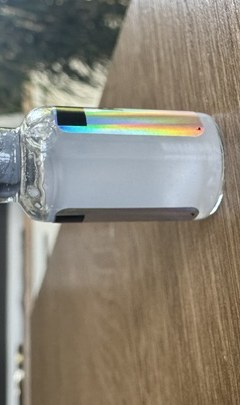 Retatrutide: persistently milky solution that settles and layers. Still not clear after resting, this is a genuine warning sign (often caused by water that is too acidic).
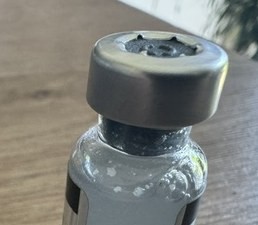 Retatrutide: milky with visible undissolved white flakes. Solid particles after resting are a warning sign, a case for replacement.
Assess first (often harmless)
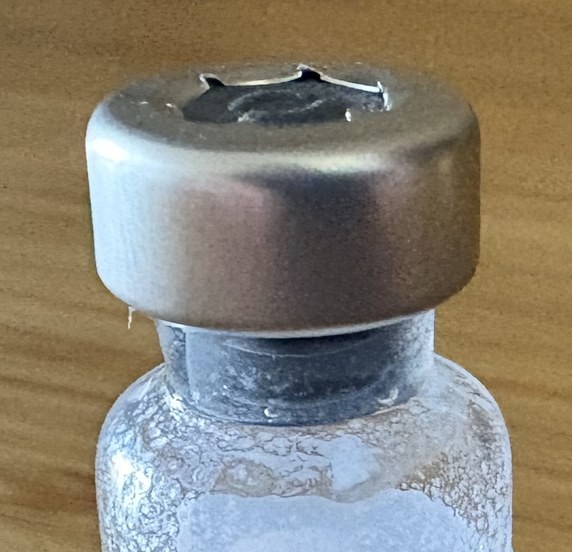 CJC-1295/Ipamorelin: milky shortly after reconstitution. Common with these blends, only assess after 15 to 20 minutes of resting and gentle swirling.
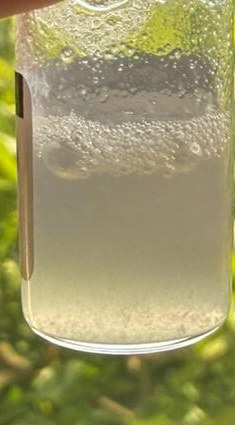 Vial held up to the light with a turbid solution and foam. Foam and bubbles from shaking settle over time, only assess clarity against a white background afterward.
Clear reference
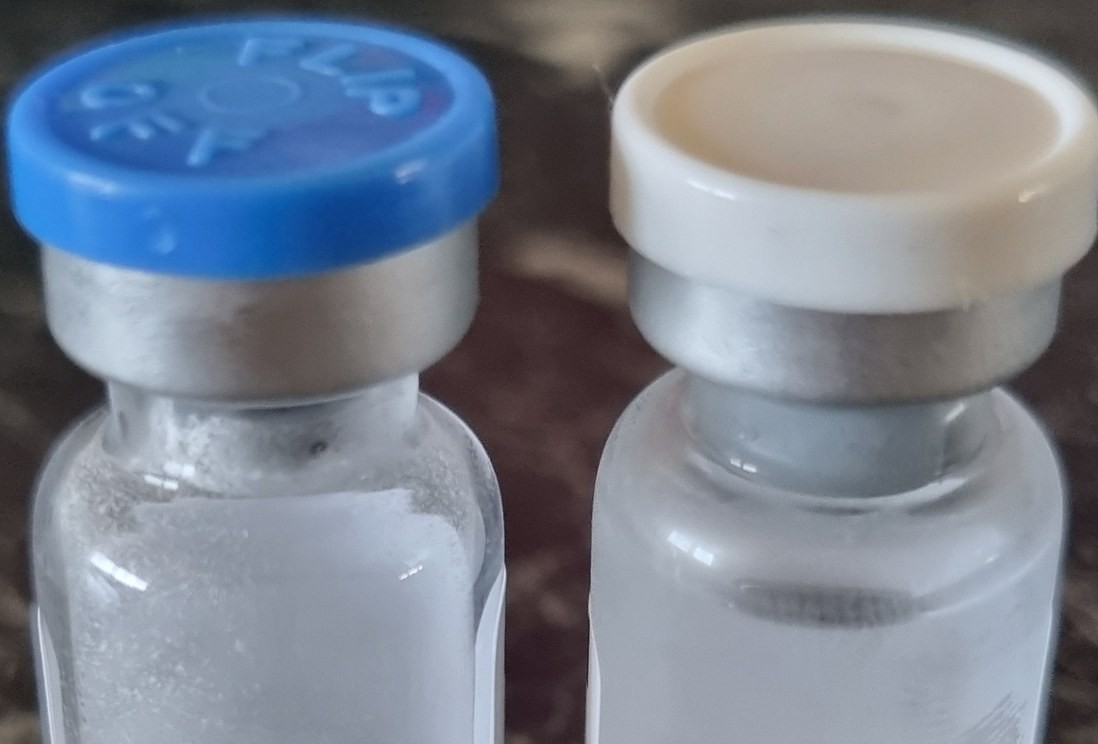 Before and after: dry lyophilized powder (left) next to the reconstituted solution (right).
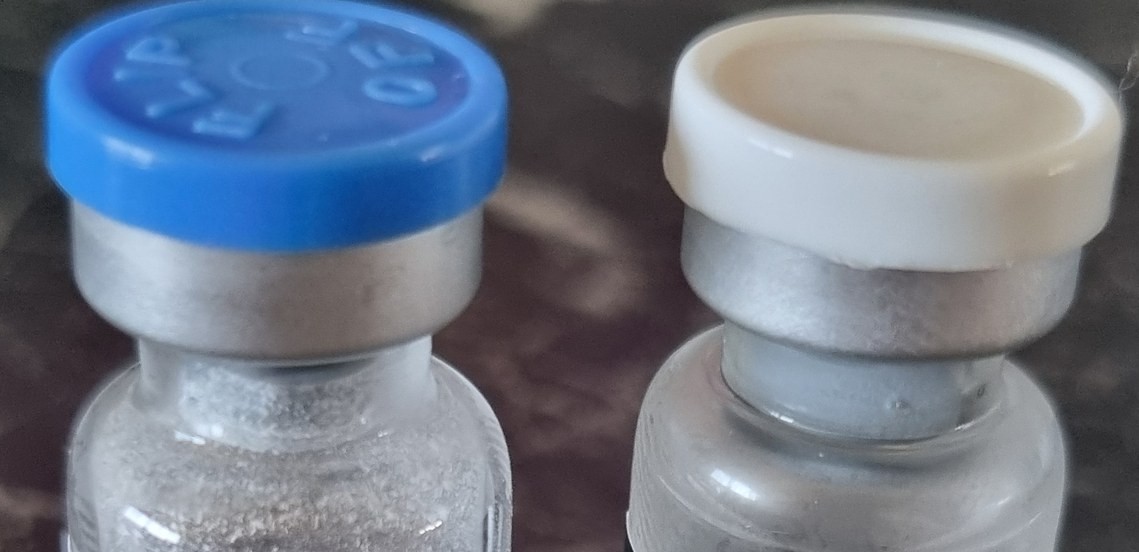 Clear reference: powder vial and bacteriostatic water before mixing, glass-clear and particle-free.
Which of our peptides are sensitive
Not every peptide is equally prone to clouding. Based on our support cases and the underlying chemistry, we keep an internal sensitivity list that also drives the reconstitution note on each product page. These peptides respond more sensitively to pH and technique:
Higher pH sensitivity
Long R3 variant of Insulin-like Growth Factor 1, modified for reduced IGFBP binding and ~20-30 hour half-life. Researched for cell proliferation, hypertrophy, and metabolic signaling. ≥99% purity.
Long-acting amylin analog studied for once-weekly satiety and appetite control. Phase 3 REDEFINE trials complete, NDA filed with FDA December 2025. A mechanism distinct from GLP-1 agonists.
Modified hGH fragment (177-191) studied for fat metabolism and lipolysis research. Interacts with beta-3 adrenergic receptors without growth-promoting effects.
Cathelicidin-derived antimicrobial peptide (37 amino acids). Researched for innate immunity, antimicrobial activity, and wound-healing pathways. ≥99% HPLC purity with Janoshik CoA.
First-ever triple-action weight management peptide targeting three receptors at once: GLP-1, GIP, and glucagon. Shown exceptional results in Phase 2 trials - up to 24% weight reduction. The most advanced metabolic peptide available.
CJC-1295 without DAC (Mod GRF 1-29) is a short-acting GHRH(1-29) analog for GH/IGF-1 research. Research-grade lyophilized powder, specified purity >=99% (HPLC). Laboratory use only.
2-in-1 growth hormone blend: CJC-1295 no-DAC (Modified GRF 1-29, 5 mg) + Ipamorelin (5 mg) combined in one vial. The CJC-1295 component is the short-acting no-DAC variant (about 30 minute half-life), not the long-acting DAC form. Stimulates natural GH release through two different pathways for amplified, more physiological growth hormone pulses.
Moderate sensitivity
Naturally occurring copper tripeptide complex for skin regeneration and anti-aging research. Stimulates collagen synthesis, accelerates wound healing, and modulates 4000+ genes. Plasma levels decline with age, making it a key target in longevity research.
4-in-1 anti-aging peptide blend: GHK-Cu 50mg + BPC-157 10mg + TB-500 10mg + KPV 10mg. Targets collagen synthesis, tissue regeneration, skin repair, and anti-inflammatory pathways.
3-in-1 skin peptide blend: GHK-Cu 50mg + BPC-157 10mg + TB-500 10mg. Targets collagen synthesis, tissue regeneration, and skin repair for comprehensive dermatological research.
GHRH(1-29) analog for physiological growth hormone stimulation research
Essential cellular coenzyme that declines with age. Powers energy metabolism in every cell, activates sirtuins (longevity genes), and supports DNA repair. A cornerstone molecule in aging and longevity research.
Two patterns deserve an explanation. GLP-1 and related lipidated peptides such as Retatrutide often turn milky or hazy at high concentration: this is well known across the market and is usually not a defect. And the CJC-1295 with Ipamorelin blends are chemically a bit more hydrophobic and more thinly lyophilized, which makes them more prone to cloudiness than robust peptides like BPC-157 or TB-500.
Copper blue-green is normal
GHK-Cu, KLOW and GLOW are copper peptide complexes. Their solution is naturally blue to blue-green, and the color intensifies at higher concentration. That is the copper, not a flaw and not a contamination. For these three products, a strong blue color is exactly what you should expect.
Best reconstitution pH by peptide (with sources)
Research peptides are not approved drugs, so there is no official per-peptide pH specification for any of them. To avoid publishing numbers we cannot stand behind, the table below anchors every value to a documented source: the pH of the water itself, the formulation pH of the closest approved drug in the same class, and the underlying solubility principle. Where a product has no official source, we say so plainly and give no link.
As a simple orientation: standard bacteriostatic water sits at about pH 5.7, which is the right, near-neutral range for the large majority of our peptides. A quick check of your own water with a cheap pH meter (see the tip above) is the reliable way to confirm it before you use it.
- Best diluent
- Standard bacteriostatic water
- Target pH
- around pH 5.7 (near-neutral)
- Source
- Water value [1] and solubility principle [7]. No per-peptide spec exists.
- Best diluent
- Near-neutral bacteriostatic water; test your water first
- Target pH
- 6.5 to 7.5
- Source
- By class analogy to approved GLP-1 drugs [2][3] (retatrutide has no approved label yet)
- Best diluent
- Dilute acetic acid, then top up with BAC water
- Target pH
- 3 to 4
- Source
- Approved IGF-1 analog Increlex is acetate-buffered [5]
- Best diluent
- Dilute acetic acid
- Target pH
- around 4
- Source
- Approved amylin analog Symlin is pH ~4 [4]; mechanism [6]
- Best diluent
- Near-neutral bacteriostatic water; do not acidify
- Target pH
- around pH 5.7
- Source
- No official source (general coordination-chemistry guidance). The blue-green color is the copper and is normal.
- Best diluent
- Near-neutral bacteriostatic water
- Target pH
- pH 5.7 to 7
- Source
- No official source (general handling)
Matching the water to the peptide is ultimately the customer's responsibility. Bacteriostatic water has its own pH that can vary by batch, so a quick pH check before you reconstitute is the cheapest way to protect an expensive vial.
Sources
- Bacteriostatic Water for Injection, USP: pH 5.7 (range 4.5 to 7.0). FDA label via DailyMed
- Ozempic (semaglutide): pH approximately 7.4. FDA label via DailyMed
- Mounjaro (tirzepatide): pH 6.5 to 7.5. FDA label via DailyMed
- Symlin (pramlintide, amylin analog): pH approximately 4.0, acetate-buffered. FDA label
- Increlex (mecasermin, IGF-1 analog): acetate-buffered, acidic. FDA label via DailyMed
- Ward et al., Journal of Medicinal Chemistry 2022 (cagrilintide series): neutral isoelectric point and low solubility at pH 6 to 8. Publication
- Peptide and protein solubility is at a minimum near the isoelectric point and rises as pH moves away from it. Protein Science
Step by step: clean technique
Most cloudiness can be avoided before it happens. Following this order noticeably lowers complaint rates.
Step 1: Bring everything to room temperature
Let the vial and BAC water sit outside the fridge for 10 to 15 minutes before mixing. Cold powder plus cold water is one of the most common causes of instant cloudiness.
Step 2: Choose concentration deliberately
Prefer a bit more water (for example, 2 ml instead of 1 ml) for sensitive or highly concentrated peptides. Less concentration means less aggregation.
Step 3: Let the water run down the wall
Position the needle against the inner wall of the vial and let the water run down the glass slowly, not squirted directly and hard onto the powder.
Step 4: Swirl, never shake
Gently roll or circle the vial until the powder dissolves. Shaking creates microbubbles and foam that look like cloudiness.
Step 5: Rest, judge, then store
Give it a few minutes at room temperature so bubbles settle and any compact powder finishes dissolving, then judge the clarity against a white background in bright light, not straight from the fridge. Important: resting only helps with bubbles and undissolved powder. If it stays cloudy after that, it is no longer a matter of time; it points to pH, concentration or a real defect, so do not keep waiting. Once it is clear, refrigerate it for storage.
If you want to calculate the right water volume for a target concentration, use our reconstitution calculator. It takes the dose, vial strength and water volume and returns units per injection.
Troubleshooting: the decision tree
The key criterion is the timing of the cloudiness. When it appears and whether it clears separates harmless from a real defect.
Cloudy immediately, clears within 5 to 20 minutes
Temporary aggregation during dissolving. Harmless. Clear, colorless and particle-free after resting means it is usable. No replacement needed.
Cloudy immediately, still cloudy after 20 minutes
First cross-check with good branded BAC water and clean technique. If it stays cloudy with 1 to 2 ml, gentle swirling and room temperature, that points to a vial or batch issue. Case for replacement.
Was clear, turns cloudy after days or weeks
This is the shelf-life limit of the reconstituted solution (roughly 2 to 4 weeks refrigerated) or contamination, often from reused BAC water. Not a defect of the powder.
Solid flakes, strands or discoloration
Visible solid particles, strands, or a yellow, pink or amber discoloration (excluding the normal blue of copper peptides) are real warning signs. Do not use, request replacement.
When replacement is warranted
For a genuine warning sign (persistent cloudiness after resting despite good technique, solid flakes or particles, discoloration outside the normal copper blue), we replace free of charge, provided a recognized diluent was used and the product-specific protocol on the product page was followed (acid first for AOD-9604 and Tesamorelin, see our fix-it guide); an acid-first peptide reconstituted in plain bacteriostatic water instead is a handling matter, not a defect. It helps processing to include a photo of the solution against a white background and the cap color or batch number for our quality control. Details are covered on our returns and replacement page.
Products that help
The three most common causes of cloudiness come down to water, concentration and technique. Good solvent and clean supplies eliminate most of these before they start.
USP-grade sterile water with 0.9% benzyl alcohol (near-neutral, pH 6.2 to 6.4) - the standard solvent for reconstituting lyophilized peptides. Essential accessory for any peptide research. Each vial is sealed and ready to use.
First-ever triple-action weight management peptide targeting three receptors at once: GLP-1, GIP, and glucagon. Shown exceptional results in Phase 2 trials - up to 24% weight reduction. The most advanced metabolic peptide available.
A first-in-class dual GIP and GLP-1 receptor agonist, and one of the most extensively studied compounds in modern metabolic and weight-regulation research. Supplied as a lyophilised research peptide with a per-batch certificate of analysis, for laboratory and in-vitro use only.
2-in-1 growth hormone blend: CJC-1295 no-DAC (Modified GRF 1-29, 5 mg) + Ipamorelin (5 mg) combined in one vial. The CJC-1295 component is the short-acting no-DAC variant (about 30 minute half-life), not the long-acting DAC form. Stimulates natural GH release through two different pathways for amplified, more physiological growth hormone pulses.
Naturally occurring copper tripeptide complex for skin regeneration and anti-aging research. Stimulates collagen synthesis, accelerates wound healing, and modulates 4000+ genes. Plasma levels decline with age, making it a key target in longevity research.
Frequently asked questions
For research use only
All products are sold strictly for laboratory and educational purposes, with no quality or therapeutic claims, and are not for consumption by humans or animals. This article is not medical advice.
Research context for English-speaking buyers
Most of our English-speaking customers ship to the UK, Ireland, Malta or other English-as-second-language EU territories. The regulatory picture differs per country.
- Relevant authorities
- MHRA (UK, post-Brexit), HPRA (Ireland, EU-aligned), FDA Section 503A bulks list (US, restricted Cat 2 status of several peptides as of 2026)
- Customs and VAT
- EU shipments include 19% VAT; UK shipments after Brexit are now extra-EU and may attract UK VAT plus a handling fee at import
- Typical shipping window
- EU 2-4 working days, UK 4-7 working days, other international 7-14 working days, depending on customs
Research-grade peptides shipped from our EU warehouse are sold for laboratory use only and are not authorised for human or veterinary therapeutic application in any of the destination jurisdictions. US customers should be aware that the FDA Section 503A bulks list classification (and the April 2026 reclassification of twelve compounds) only governs compounding pharmacies, not direct-to-researcher imports for non-clinical work. UK buyers should declare the consignment on import and may be asked for a research justification by HMRC. We provide a CoA per batch identified by colour code rather than serial number; customs sometimes asks for this document when clearing the parcel.