In Vitro, In Vivo or Clinical? A Model-Literacy Guide for Reading Peptide Research
How to weight a peptide claim by whether it came from a dish, a mouse or a human trial, why striking preclinical results so often fail in people, and an honest evidence map of six research peptides.
TL;DR: The first question to ask of any peptide claim
Was it a dish, an animal, or a human? That single question tells you most of what you need to know about how much weight a peptide finding deserves. Only about 5 percent of animal-tested interventions ever reach regulatory approval (PMID 38870090), and animal-to-human agreement ranges unpredictably from 0 to 100 percent (PMID 31307492). A mouse is not a small human: doses do not transfer milligram-for-milligram (a mouse mg/kg dose is roughly 12 times the human-equivalent, PMID 27057123), and species differ in metabolism, receptors and physiology. A clear mechanism does not guarantee an outcome: SS-31 (elamipretide) has an elegant mitochondrial mechanism and still failed its pivotal Phase 3 trial on both primary endpoints (PMID 37268435). This guide is compliance-positive: it teaches you to bound and discount claims, not amplify them.
Peptide marketing runs on a quiet fallacy: "a study showed it works." But a study in a dish and a randomized human trial are separated by an enormous gap, and most compounds fall into it. This guide teaches the single most useful research-literacy skill: reading a peptide claim by the model it came from. It uses six of our stocked research peptides as worked examples, and it is written for laboratory research context only. Nothing here is dosing guidance or a treatment claim; the point is the opposite, to help you weight evidence honestly.
Bacteriostatic water and research supplies
Three Questions to Ask of Any Peptide Study
Before anything else, place the study on one of three rungs:
- In vitro (Latin, "in glass"): cells, tissue fragments or purified molecules in a dish or tube.
- In vivo: a whole living organism, almost always a rodent for early peptide work.
- Clinical: humans, structured as Phase 1 (safety), Phase 2 (first efficacy signal, dose finding), Phase 3 (large confirmatory randomized trial) and Phase 4 (post-marketing).
Adequately designed Phase 2 and especially Phase 3 trials can test clinical efficacy; Phase 1 gives human safety and pharmacokinetics, and earlier or observational evidence answers narrower questions but cannot confirm efficacy.
What "In Vitro" Can Never Tell You
A dish isolates one mechanism cleanly, which is its strength and its trap. It has no blood supply, no liver, no kidneys and no whole-organism pharmacokinetics, so it cannot tell you whether a compound ever reaches its target in a living body. A peptide can bind a receptor potently in vitro and still fail because it is poorly absorbed, rapidly degraded by peptidases, cleared before reaching the tissue, or heavily protein-bound. There is also a concentration trap: many striking in vitro effects use peptide concentrations far above anything safely achievable in human plasma, so the effect can be real in the dish yet unreachable in a person.
What "In Vivo" Adds, and Why a Mouse Is Not a Small Human
An animal study adds ADME (absorption, distribution, metabolism, excretion) and multi-organ feedback that a dish lacks. But it substitutes rodent biology for human biology, and two gaps bite hard.
Dose scaling and species differences (PMID 27057123)
Physiological rates scale with body surface area, not body mass, so mg/kg does not transfer across species. Converting with the Km factor, a mouse dose is roughly 12 times the equivalent human mg/kg dose (and a rat dose roughly 6 times, standard allometric scaling). "The dose that worked in mice" is therefore meaningless without conversion. On top of that, receptor sequences, metabolic enzymes (such as CYP450 isoforms), immune architecture, gut physiology and lifespan all differ between rodents and humans. A positive mouse result encodes mouse biology as much as drug effect.
The Numbers That Keep You Honest
How often preclinical promise survives to humans
Across 367 interventions spanning 54 human diseases, only about 5 percent of animal-tested interventions reached regulatory approval; half advanced to any human study and 40 percent to randomized trials, with most attrition from lack of efficacy or unexpected toxicity in humans (PMID 38870090). Reported animal-to-human concordance spans the entire 0 to 100 percent range with no clear pattern by species or study size, so a single positive animal study carries very little predictive weight (PMID 31307492). In oncology the translation rate is under 8 percent (PMID 24489990). These are all-field estimates, context for reading claims, not predictions about any one compound.
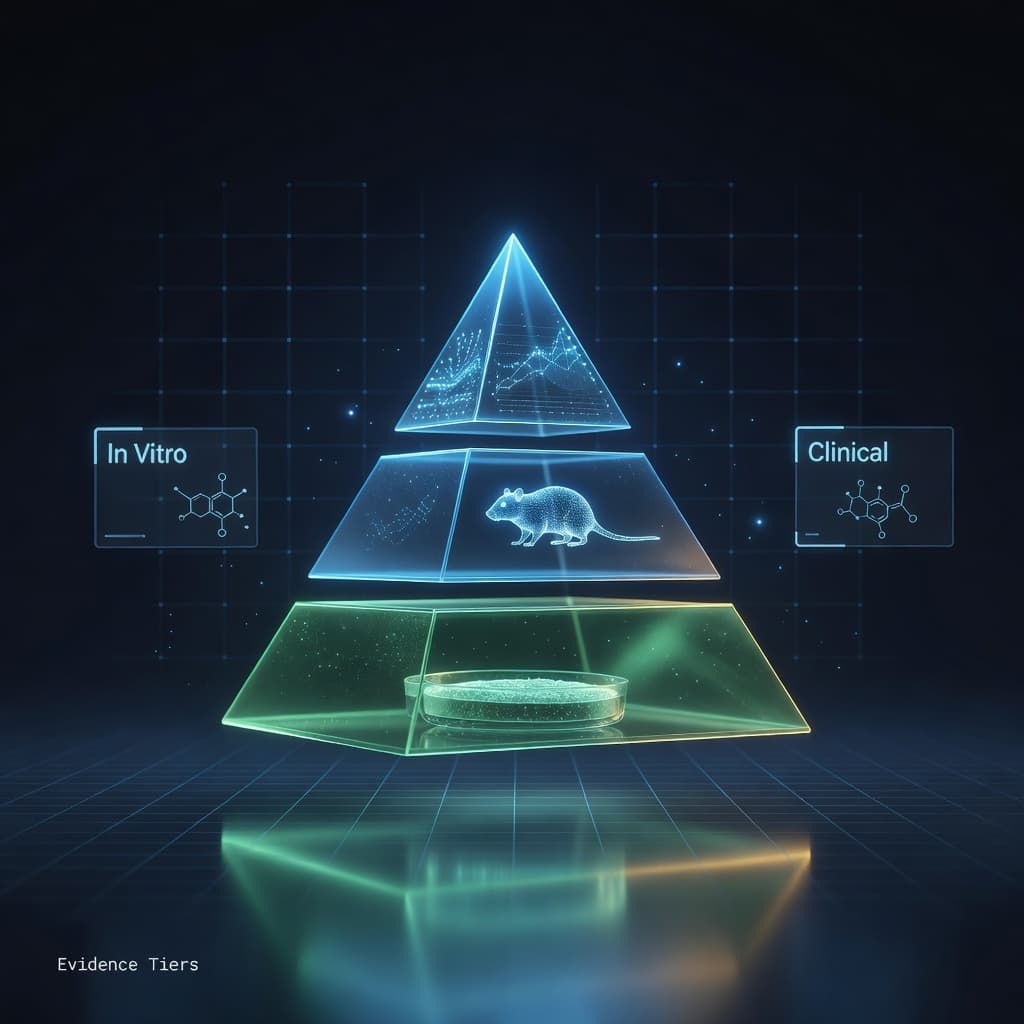
The evidence pyramid, weakest to strongest: mechanistic reasoning and in vitro assays, then animal in vivo studies, then human case reports and observational data, then randomized controlled trials, then systematic reviews that pool multiple trials. Higher tiers control more confounders. And a structural warning: positive-result and publication bias systematically inflate apparent effect sizes in the animal literature (PMID 31307492), which is one reason striking preclinical results shrink or vanish in people.
Case Study: Reading a BPC-157 Headline
BPC-157 is the perfect exercise. Its consistently positive effects were demonstrated almost entirely in rodents, and its pharmaceutical development remains rudimentary, with no approved formulation, no validated dosing regimen and no completed Phase II clinical trial (PMID 40005999). Preclinical toxicity studies in mice, rats, rabbits and dogs found it well tolerated with no serious toxicity (PMID 32334036), but that is animal safety data and does not establish safety in humans. So a "BPC-157 heals X" headline is a rodent hypothesis, and the reassuring tolerability is a rodent finding too.
Gastric pentadecapeptide (15 amino acids) known for exceptional tissue repair properties. Promotes wound healing, angiogenesis, and cytoprotection across tendons, muscles, gut, and nerves. Over 30 years of preclinical research.
Case Study: TB-500 and the Indication Switch
Thymosin beta-4 (marketed as TB-500) has a large animal tissue-repair literature showing promotion of cell migration, angiogenesis, reduced apoptosis and re-epithelialization (PMID 20536453). It has even reached human Phase 3 trials, but for ophthalmic indications such as dry eye and neurotrophic keratopathy (PMID 30063853), not the musculoskeletal healing uses TB-500 is popularly associated with. Reading it correctly means not transferring the eye-trial credibility onto the animal-level injury-healing claims.
Full-length 43-amino-acid Thymosin Beta-4, a naturally occurring repair protein, independently confirmed by a third-party CoA from Janoshik. Promotes cell migration and new blood vessel formation for systemic tissue healing. Especially researched for muscle, tendon, and cardiac repair.
Case Study: MOTS-c and the Direction of the Arrow
MOTS-c injections improved running capacity in young, middle-aged and old mice (PMID 33473109). But the confirmed human finding runs the other way: exercise induces endogenous MOTS-c in skeletal muscle and circulation. That is not the same as injected MOTS-c improving human performance. Watch the direction of the arrow: "exercise raises MOTS-c in people" is not "MOTS-c raises performance in people".
Mitochondrial-derived signaling peptide (16 amino acids) that mimics the effects of exercise at the cellular level. Activates AMPK, improves glucose uptake, and enhances fat metabolism - a key tool in metabolic and longevity research.
Case Study: SS-31, When Phase 2 Promise Met a Failed Phase 3
This is the single strongest caution in the guide. SS-31 (elamipretide) has an elegant mechanism: it selectively binds cardiolipin in the inner mitochondrial membrane to stabilize cristae, reduce reactive oxygen species and support ATP production, with protective efficacy shown largely in preclinical models (PMID 39940712). It has the most advanced human program of the six peptides here. And yet the pivotal Phase 3 MMPOWER-3 trial in 218 patients failed both primary endpoints (6-minute walk distance difference -3.2 m, p=0.69; fatigue difference -0.07, p=0.37) (PMID 37268435). A clear mechanism and encouraging earlier-phase data did not deliver a confirmatory outcome. Those trials used a regulated pharmaceutical product under clinical conditions and say nothing about the safety or efficacy of research-grade material.
Mitochondria-targeted tetrapeptide (Elamipretide) that stabilizes cardiolipin and prevents ROS formation at the source.
Two More on the Preclinical Tier
Epitalon extended mean and maximum lifespan by about 12 percent and reduced malignant lymphoma incidence in female mice (PMID 14501183), a dramatic rodent longevity result with no equivalent human randomized trial and evidence largely from a single research lineage. GHK-Cu produced a concentration-dependent increase in collagen, DNA, protein and glycosaminoglycan (extracellular matrix) in rat wound chambers in vivo (PMID 8227353); its credible human evidence is topical cosmetic use, not systemic injection, so the dish and rat ECM findings should not be extrapolated to systemic anti-aging in people.
Tetrapeptide (Ala-Glu-Asp-Gly) that activates telomerase, the enzyme responsible for maintaining telomere length. One of the most studied peptides in longevity research, developed by Prof. Khavinson at the St. Petersburg Institute of Bioregulation.
Naturally occurring copper tripeptide complex for skin regeneration and anti-aging research. Stimulates collagen synthesis, accelerates wound healing, and modulates 4000+ genes. Plasma levels decline with age, making it a key target in longevity research.
An Honest Evidence Map
Where these six actually sit
SS-31: most advanced human program (multiple Phase 2/3), but the pivotal Phase 3 failed. TB-500 / thymosin beta-4: Phase 3 only in ophthalmology; musculoskeletal claims are animal-level. MOTS-c: strong rodent data; the only confirmed human finding is that exercise raises endogenous MOTS-c. BPC-157, Epitalon, GHK-Cu: essentially preclinical (rodent and in vitro) for their headline systemic claims. The products sold here are laboratory reference materials, not medicines or EMA-authorised medicinal products, for the uses they are popularly associated with. Separately, the regulated pharmaceutical elamipretide product Forzinity received FDA accelerated approval in 2025 for Barth syndrome; that product and indication do not establish the safety or efficacy of research-grade SS-31, and the MMPOWER-3 failure in primary mitochondrial myopathy is a separate result.
Regeneration and repair research (preclinical tier)
Gastric pentadecapeptide (15 amino acids) known for exceptional tissue repair properties. Promotes wound healing, angiogenesis, and cytoprotection across tendons, muscles, gut, and nerves. Over 30 years of preclinical research.
Full-length 43-amino-acid Thymosin Beta-4, a naturally occurring repair protein, independently confirmed by a third-party CoA from Janoshik. Promotes cell migration and new blood vessel formation for systemic tissue healing. Especially researched for muscle, tendon, and cardiac repair.
Naturally occurring copper tripeptide complex for skin regeneration and anti-aging research. Stimulates collagen synthesis, accelerates wound healing, and modulates 4000+ genes. Plasma levels decline with age, making it a key target in longevity research.
Mitochondrial and metabolic research
Mitochondria-targeted tetrapeptide (Elamipretide) that stabilizes cardiolipin and prevents ROS formation at the source.
Mitochondrial-derived signaling peptide (16 amino acids) that mimics the effects of exercise at the cellular level. Activates AMPK, improves glucose uptake, and enhances fat metabolism - a key tool in metabolic and longevity research.
A 60-Second Checklist for Any Peptide Claim
- Dish, animal or human? For efficacy, evidence below an adequately designed Phase 2 is generally hypothesis-generating, though Phase 1 still gives human safety and pharmacokinetic data.
- If animal, was the dose converted to a human-equivalent, or quoted raw?
- If in vitro, is the concentration achievable in human plasma?
- Is there a completed, adequately powered randomized human trial, or just early-phase and preclinical signals?
- Does the mechanism story stand in for an outcome that was never measured?
Research Context and Handling
BPC-157, TB-500, MOTS-c, Epitalon, GHK-Cu and SS-31 are supplied for laboratory research only and are not medicines, supplements or authorised medicinal products, and are not for human or veterinary use. This article gives no dosing or administration guidance; study parameters belong to their cited studies. The pharmaceutical trials referenced (elamipretide, thymosin beta-4 eye studies) are evidence-literacy context, not evidence about research-grade material. Verify identity and purity against a batch-specific third-party Certificate of Analysis. See the peptide half-life chart and how to read a peptide CoA for related handling references.
Frequently Asked Questions
This article is for research and educational purposes only. It teaches how to weight scientific evidence; the peptide findings cited are described at their actual model level (in vitro, animal or clinical), and pharmaceutical trials are referenced only as literacy context. Nothing here is medical advice, a health claim, dosing guidance or a recommendation for use. All compounds mentioned are sold exclusively for laboratory research.
Research context for English-speaking buyers
Most of our English-speaking customers ship to the UK, Ireland, Malta or other English-as-second-language EU territories. The regulatory picture differs per country.
- Relevant authorities
- MHRA (UK, post-Brexit), HPRA (Ireland, EU-aligned), FDA Section 503A bulks list (US, restricted Cat 2 status of several peptides as of 2026)
- Customs and VAT
- EU shipments include 19% VAT; UK shipments after Brexit are now extra-EU and may attract UK VAT plus a handling fee at import
- Typical shipping window
- EU 2-4 working days, UK 4-7 working days, other international 7-14 working days, depending on customs
Research-grade peptides shipped from our EU warehouse are sold for laboratory use only and are not authorised for human or veterinary therapeutic application in any of the destination jurisdictions. US customers should be aware that the FDA Section 503A bulks list classification (and the April 2026 reclassification of twelve compounds) only governs compounding pharmacies, not direct-to-researcher imports for non-clinical work. UK buyers should declare the consignment on import and may be asked for a research justification by HMRC. We provide a CoA per batch identified by colour code rather than serial number; customs sometimes asks for this document when clearing the parcel.