KLOW vs WOLVERINE vs GLOW: Which Healing Blend for Your Research Goal?
KLOW, WOLVERINE and GLOW compared: exact composition, active ingredients and evidence. The decision guide for the regeneration blends.
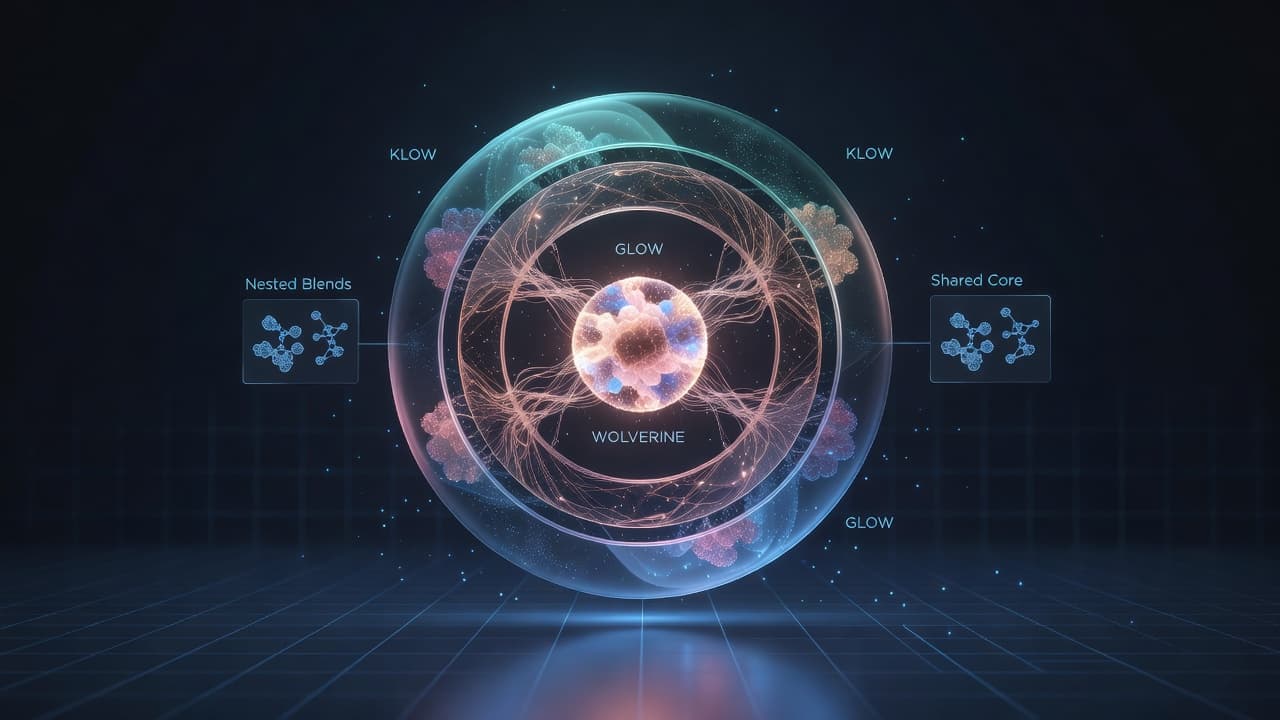
Three of our most widely used regeneration blends share a common backbone of BPC-157 and TB-500, but differ clearly in what they additionally cover. This guide helps with the selection: which blend fits which research goal, what exactly is in it and how robust the evidence is for each component.
This is about the decision between ready-made blends, not about the individual mechanisms. If you first want to compare BPC-157 and TB-500 in detail, read BPC-157 vs TB-500. Here the focus is on the blend choice.
TL;DR: The Quick Decision
WOLVERINE: the pure healing duo (BPC-157 + TB-500), lean and focused on tissue and tendon regeneration. GLOW: WOLVERINE logic plus GHK-Cu, so it additionally adds the collagen and skin layer. KLOW: GLOW plus KPV, the broadest blend, additionally covering the inflammation-modulating axis. Mnemonic: KLOW = GLOW + KPV, and GLOW = the healing duo + GHK-Cu.
For Research Purposes Only
This text classifies research peptides. It is not medical advice, not a recommendation for human use and does not replace consultation with a physician. None of the blends mentioned is an approved medicinal product.
Quick Selection by Research Goal
Pure tendon and soft-tissue repair, lean
Skin, collagen and wound healing
The Three Blends in Detail
WOLVERINE: the pure healing duo
WOLVERINE combines the two most-studied repair peptides in one vial: BPC-157 (5 mg) + TB-500 (5 mg). The two complement each other mechanistically:
- BPC-157 is a synthetic 15-amino-acid peptide that drives angiogenesis via the VEGFR2 and the Akt-eNOS/NO axis and modulates cell adhesion and cell migration. In animal models and cell culture it promoted tendon healing and the migration of tendon fibroblasts [PMID 21030672]; a vascular mechanism of action via the Src-Caveolin-1-eNOS pathway has been described [PMID 33051481].
- TB-500 as supplied here is the full-length 43-amino-acid Thymosin beta-4 (CoA-confirmed); the name "TB-500" is also used in the market for a short Ac-LKKTETQ fragment, which is exactly why a CoA matters: the Janoshik CoA certifies the full 43-amino-acid form. Its active region is the actin-binding Ac-LKKTETQ motif, so it binds monomeric G-actin and thereby regulates the actin pool that lets fibroblasts, endothelial and progenitor cells migrate into a wound; it also promotes angiogenesis and dampens inflammation [PMID 10469335].
WOLVERINE is the lean, cost-effective entry point when the research interest lies purely in tendon, ligament, muscle and systemic soft-tissue repair.
The Wolverine Stack: BPC-157 + TB-500 in equal parts in one vial (50/50: 10mg = 5mg each, 20mg = 10mg each). The most researched healing peptide duo for tissue repair, tendon recovery, and systemic regeneration. Batch-specific Janoshik COA.
GLOW: the healing duo plus collagen layer
GLOW takes the BPC-157 and TB-500 backbone and adds GHK-Cu, giving GHK-Cu (50 mg) + BPC-157 (10 mg) + TB-500 (10 mg).
GHK-Cu is a naturally occurring, copper-binding tripeptide complex. It delivers copper as an enzymatic cofactor for collagen cross-linking and antioxidant defense, and the GHK fragment modulates larger gene programs toward a regenerative profile. The direct stimulation of collagen synthesis in fibroblasts is the founding observation [PMID 3169264], an upregulation of collagen IV in skin models has been described [PMID 37062921], plus a review of the gene effects [PMID 29986520].
GLOW thus shifts the focus from pure tissue repair toward skin, collagen and matrix. The reconstituted solution takes on a slightly bluish tint due to the copper complex.
3-in-1 skin peptide blend: GHK-Cu 50mg + BPC-157 10mg + TB-500 10mg. Targets collagen synthesis, tissue regeneration, and skin repair for comprehensive dermatological research.
KLOW: the broadest blend
KLOW is the strict extension of GLOW with KPV, giving GHK-Cu (50 mg) + BPC-157 (10 mg) + TB-500 (10 mg) + KPV (10 mg). KLOW = GLOW + KPV.
KPV (Lys-Pro-Val) is the C-terminal tripeptide of alpha-MSH and acts in an inflammation-modulating way: it suppresses the nuclear translocation of NF-kB and is taken up in the intestinal epithelium via the PepT1 transporter. The canonical work showed a reduced inflammatory response in mouse colitis models and in human epithelial cells [PMID 18061177].
KLOW is thus the only one of the three blends that, in addition to structural repair, the collagen layer and cell migration, also covers the inflammation-modulating axis. Anyone who wants maximum breadth across multiple pathways, or who is undecided, is in the right place here.
4-in-1 anti-aging peptide blend: GHK-Cu 50mg + BPC-157 10mg + TB-500 10mg + KPV 10mg. Targets collagen synthesis, tissue regeneration, skin repair, and anti-inflammatory pathways.
Direct Comparison at a Glance
- WOLVERINE
- BPC-157 5 mg + TB-500 5 mg
- GLOW
- GHK-Cu 50 + BPC-157 10 + TB-500 10
- KLOW
- GHK-Cu 50 + BPC-157 10 + TB-500 10 + KPV 10
- WOLVERINE
- 2
- GLOW
- 3
- KLOW
- 4
- WOLVERINE
- Base healing duo
- GLOW
- + GHK-Cu (collagen/skin)
- KLOW
- + KPV (inflammation axis)
- WOLVERINE
- tendon/ligament/muscle
- GLOW
- skin/collagen/wound
- KLOW
- broadest multi-pathway coverage
- WOLVERINE
- clear
- GLOW
- slightly bluish (copper)
- KLOW
- slightly bluish (copper)
- WOLVERINE
- lean, focused
- GLOW
- dermal/regenerative
- KLOW
- broad, superset of GLOW
Handling the Copper-Containing Blends
GLOW and KLOW contain GHK-Cu, so the reconstituted solution is slightly bluish and light-sensitive. Store protected from light and refrigerated (2-8 degrees) and use promptly after dissolving. The mixing ratios are fixed by the blend, the components cannot be dosed individually.
Which Blend Fits Which Goal?
Pure tendon, ligament or soft-tissue repair
Skin, collagen, dermal regeneration
Broadest coverage across multiple pathways
An Honest Classification of the Evidence
No blend as a fixed combination (WOLVERINE, GLOW, KLOW) has a human efficacy study; the synergy rationale is mechanistic, not clinically proven. Per individual component, from strongest to thinnest evidence: GHK-Cu (in vitro, animal and topical human data, but not systemically injected), BPC-157 (large animal and in vitro corpus, in humans only a safety pilot study [PMID 40131143], no efficacy), TB-500 (the supplied material is full-length 43-amino-acid Thymosin beta-4, CoA-confirmed, so the published Thymosin beta-4 literature applies directly; that evidence is still thin and animal-heavy in humans), KPV (one strong colitis paper in animal and cell culture [PMID 18061177], no human data). Please do not over-interpret.
Individual Components Instead of a Blend?
Anyone who wants to study the components in their own ratios rather than in the fixed blend ratio can also find them individually:
The repair backbone individually
Gastric pentadecapeptide (15 amino acids) known for exceptional tissue repair properties. Promotes wound healing, angiogenesis, and cytoprotection across tendons, muscles, gut, and nerves. Over 30 years of preclinical research.
Full-length 43-amino-acid Thymosin Beta-4, a naturally occurring repair protein, independently confirmed by a third-party CoA from Janoshik. Promotes cell migration and new blood vessel formation for systemic tissue healing. Especially researched for muscle, tendon, and cardiac repair.
The add-on components individually
Naturally occurring copper tripeptide complex for skin regeneration and anti-aging research. Stimulates collagen synthesis, accelerates wound healing, and modulates 4000+ genes. Plasma levels decline with age, making it a key target in longevity research.
Anti-inflammatory tripeptide derived from alpha-MSH (positions 11-13). Inhibits NF-kB signaling, supports gut barrier integrity, and shows antimicrobial activity. A targeted approach to inflammation research without broad immunosuppression.
Frequently Asked Questions
The substances described here are research peptides. This article serves educational purposes only, is not medical advice and is not to be understood as a recommendation for human use.
Research context for English-speaking buyers
Most of our English-speaking customers ship to the UK, Ireland, Malta or other English-as-second-language EU territories. The regulatory picture differs per country.
- Relevant authorities
- MHRA (UK, post-Brexit), HPRA (Ireland, EU-aligned), FDA Section 503A bulks list (US, restricted Cat 2 status of several peptides as of 2026)
- Customs and VAT
- EU shipments include 19% VAT; UK shipments after Brexit are now extra-EU and may attract UK VAT plus a handling fee at import
- Typical shipping window
- EU 2-4 working days, UK 4-7 working days, other international 7-14 working days, depending on customs
Research-grade peptides shipped from our EU warehouse are sold for laboratory use only and are not authorised for human or veterinary therapeutic application in any of the destination jurisdictions. US customers should be aware that the FDA Section 503A bulks list classification (and the April 2026 reclassification of twelve compounds) only governs compounding pharmacies, not direct-to-researcher imports for non-clinical work. UK buyers should declare the consignment on import and may be asked for a research justification by HMRC. We provide a CoA per batch identified by colour code rather than serial number; customs sometimes asks for this document when clearing the parcel.