What a Peptide Vial May Look Like: Cake, Powder, Film, Blue, Yellow, Cloudy, Flakes, and What Each One Actually Tells You
Why freeze-dried peptides look so different vial to vial, what blue, yellow, cloudy or flaky really indicates, and why appearance cannot stand in for a certificate.
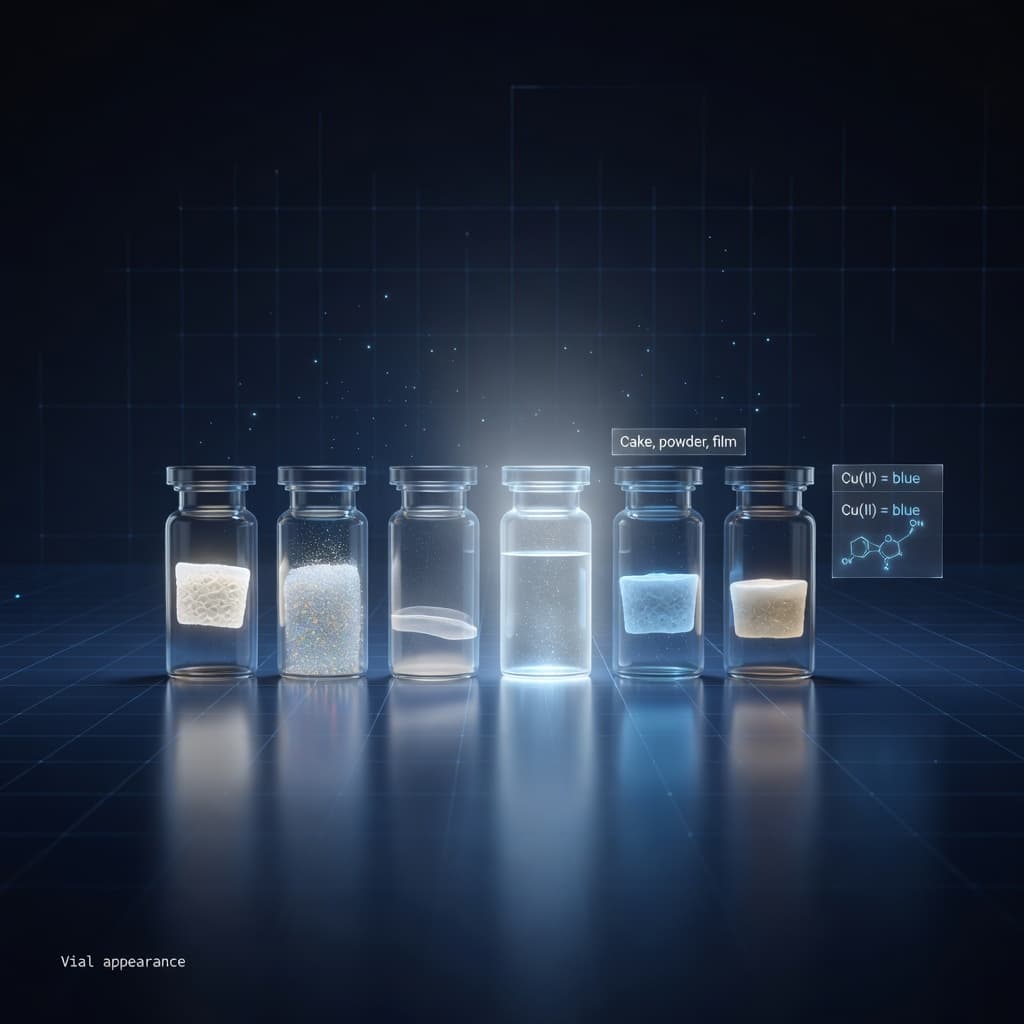
Ask any research-peptide community what a normal vial should look like and the photos arrive almost immediately: a chalky white puck, a barely visible film, a blue-tinted powder, a solution turned cloudy overnight. The question underneath nearly all of them is the same: is this normal, or did something go wrong. This article works through what the pharmaceutical freeze-drying and peptide-stability literature has actually documented about cake appearance, color, particles and cloudiness, separating what those signs can tell you from what only a certificate of analysis can. It contains no reconstitution volumes, no fix-it steps and no claims about our own batches, only what the evidence indicates.
TL;DR: what appearance does and does not tell you
- Cake shape is a process fingerprint, not a purity signal. Collapse, cracking, shrinkage and fogging follow the freeze-drying process and the formulation; the literature judges most variations acceptable unless correlated with other quality attributes.
- Mass is not volume. Visible cake or film follows fill volume and solids content, not the milligram label, so a 6 mg and a 12 mg vial can look alike.
- Color follows chemistry, not condition. Blue is copper-complex chemistry, a distinct yellow is not a property of intact NAD+, and a brown speck is a foreign particle.
- Cloudiness has a documented chemistry. Counterion type, pH, concentration, lipidation and temperature are all documented factors, and none can be diagnosed by looking at the vial.
- Identity and purity live in a certificate, not in the glass. Appearance is at most a release-time attribute; identity and purity are chromatographic and mass-spectrometric measurements.
Research use only
GHK-Cu, NAD+, retatrutide and the other peptides discussed below are sold here as laboratory research materials, not as medicines or cosmetics, and not for administration to a person or animal. This article reviews what freeze-dried peptides can look like before and after reconstitution; it contains no reconstitution volumes, technique or dosing instructions, and no community report below is an endorsement of what was tried.
Naturally occurring copper tripeptide complex for skin regeneration and anti-aging research. Stimulates collagen synthesis, accelerates wound healing, and modulates 4000+ genes. Plasma levels decline with age, making it a key target in longevity research.
Essential cellular coenzyme that declines with age. Powers energy metabolism in every cell, activates sirtuins (longevity genes), and supports DNA repair. A cornerstone molecule in aging and longevity research.
First-ever triple-action weight management peptide targeting three receptors at once: GLP-1, GIP, and glucagon. Shown exceptional results in Phase 2 trials - up to 24% weight reduction. The most advanced metabolic peptide available.
Bacteriostatic water and research supplies
What people ask, and how often
Our own Reddit corpus, covering the 12 months to August 2026 across r/Retatrutide, r/Biohackers, r/Peptides, r/tirzepatidecompound, r/PeptideDiscussion, r/Semaglutide, r/BPC157 and r/SARMSourcetalk, is a community report, not a scientific sample. It contains 2,082 posts with an appearance term (cloudy, blue, yellow, powder, cake, flakes, gel, foam, or similar) in the title, or in the body paired with a question about whether the vial looks right. Within four research-oriented subreddits, r/Retatrutide, r/Peptides, r/PeptideDiscussion and r/Biohackers, 779 posts carry the term in the title; counting every such post title or body, those four total r/Retatrutide 749, r/Biohackers 486, r/Peptides 368 and r/PeptideDiscussion 129. YouTube content was not reviewed.
- Posts
- 394
- Posts
- 285
- Posts
- 248
- Posts
- 191
- Posts
- 189
- Posts
- 118
- Posts
- 116
- Posts
- 111
- Posts
- 81
- Posts
- 79
- Posts
- 16
Retatrutide dominates which peptide gets named, about 640 mentions combining "reta" and "retatrutide," followed by GHK-Cu (about 130), tirzepatide (about 110), BPC-157 (60), CJC-1295 (39), GLOW (28), NAD+ (26), KLOW (25), tesamorelin (23), MOTS-c (22) and semaglutide (22).
A handful of threads illustrate the pattern, cited here by title only, community reports rather than evidence. "Cloudy Reta" (41 upvotes, 113 comments) asks the bare question; "Reta is milky color" describes a batch reconstituting with foam and a white ring, milky in the morning, clear within minutes, compared by the poster to tesamorelin. "Reta Gone Cloudy After 2 Days in fridge" and "Cloudy after a week" describe a vial clear at reconstitution that clouded days later in the fridge. "Blue reta after reconstitution" is a first-time buyer whose retatrutide turned dark blue; "Blue Cap Hysteria" argues the opposite, that cap color says nothing and batch numbers do, citing a 94% purity result read as degradation rather than a fake. "Ghk-cu not blue" has a vendor telling a buyer non-blue GHK-Cu is normal. "Lyophilization and powder quantity" compares 6 mg and 12 mg vials holding what looked like the same powder; "More powder than expected" is the reverse, a new supplier's 5 mg vials holding visibly more than an old supplier's 10 mg. "Just got Reta 30. Does the powder breaking mean anything?" and "Ta1 Cloudy at Reconstitution" ask about a broken cake and thymosin alpha-1 vials cloudy with particles on reconstitution. "TA1 with flakes inside. Is this normal?" is a vial frozen for months that showed flakes on reconstitution, and "Speck in powder." is a single brown speck in the powder. "HGH Frag became gel?!," "tesamorelin keeps turning cloudy and gel like" and "Tesa Cloudy, Supplier said it needs AA water" describe gel-like or persistently cloudy vials, the tesamorelin thread noting 3 of 4 vials affected while other peptides in the same fridge stayed clear. "Empty vial" and "Looks empty" describe a barely visible film a supplier called product stuck to the glass. "Cloudy Reta fix?" and "Cloudy Reta experiment (tfa salt issue) update" describe users blaming TFA salts, measuring pH 6 and reporting that phosphate-buffered saline cleared it, reported only as an attempt, untested and outside any documented protocol, never a method.
Before any water: what a freeze-dried cake may look like
Before any question of dissolving, the freeze-dried cake itself carries information, just not the information most threads are looking for. Patel et al. 2017, a peer-reviewed paper, states plainly that cake appearance "may or may not be critical with respect to product quality," and that "sometimes a non-ideal cake appearance has no impact on product quality and is an inherent characteristic of the product" due to formulation, presentation and the freeze-drying process itself. The paper proposes a harmonized nomenclature for variations from the ideal, uniform cake, and a science- and risk-based approach to deciding which variations matter.
- Status in the pharmaceutical literature
- Treated as unacceptable in a finished product
- Status in the pharmaceutical literature
- Treated as unacceptable in a finished product
- Status in the pharmaceutical literature
- Named variation, judged case by case
- Status in the pharmaceutical literature
- Named variation, judged case by case
- Status in the pharmaceutical literature
- Named variation, judged case by case
- Status in the pharmaceutical literature
- Named variation, judged case by case
- Status in the pharmaceutical literature
- Cosmetic-looking; in one batch it correlated with compromised container closure integrity, not with aggregation, protein concentration or residual moisture
- Status in the pharmaceutical literature
- Cosmetic; with adequate residual seal force, container closure integrity was not impacted for fogging in the neck region of the vial
None of that nomenclature reads a milligram number off the glass. A vial's visible cake or film follows fill volume, solids content and the freeze-drying process, not the label, as the "Lyophilization and powder quantity" and "More powder than expected" threads cited earlier illustrate: a 12 mg and a 6 mg vial can look alike, and a few milligrams without a bulking agent can dry to a thin film close to empty. Bulking-agent and fill details differ by product and are not reproduced here; the point, per Patel, is that appearance tracks formulation and process, not the label.
Mehta et al. 2018 found product on the stopper in about 40% of vials in one antibody batch: aggregation, protein concentration and residual moisture "showed no significant difference" versus normal vials, but container closure integrity was compromised, a cosmetic-looking defect that mattered for the seal, not the molecule. Murphy et al. 2026 found a different, conditional outcome for fogging: with adequate residual seal force, container closure integrity "is not impacted by fogging in the neck region of the vial." Ohori and Akita 2019 add that collapse of an amorphous cake can be induced by the drying cycle itself, a slow shelf-ramp lowering the effective collapse temperature, a fingerprint of how the batch was dried. Costantino, Langer and Klibanov's 1994 insulin study, an analogy from a protein rather than a peptide, found elevated temperature and moisture drive aggregation in the solid state, correlating with water uptake, a degradation route that can leave a cake sticky, shrunken or glassy before any water is added.
Counterions: the TFA question
One recurring theory in cloudy-vial threads reaches for chemistry rather than a defect: residual trifluoroacetic acid (TFA) from synthesis shifted the pH of the reconstituted solution. The chemistry is real. Roux et al. 2008 notes most synthetic peptides, made by solid-phase synthesis, are obtained "in the presence of trifluoroacetic acid (TFA) and, for cationic peptides, as trifluoroacetate salts," with exchange to another counterion such as acetate often required afterward. Erckes et al. 2025 confirms that synthesis and purification "strongly rely on trifluoroacetic acid (TFA) as a cleavage agent and ion-pairing reagent, respectively," and that "numerous studies highlight the negative impact of using peptides from TFA salts in biological assays." Sahakijpijarn et al. 2019 adds that acetate counterions are "a safer and more acceptable choice for peptides than others (e.g., trifluoroacetate counterions)," that volatile counterions can be lost during lyophilization, and that this loss "affects the stability of CSP7 due to the pH shift of reconstituted solutions, thereby causing peptide aggregation."
That makes the community's TFA reading chemically coherent: counterion type and content can shift the pH of an unbuffered solution, and pH shifts change solubility. It remains one candidate among several, not a confirmed diagnosis, and that pH cannot be judged by eye; the threads cited earlier measuring pH 6 and reporting that phosphate-buffered saline cleared a vial are reported only as an attempt, untested and outside any documented protocol. A pH-meter reading of unbuffered water is itself method-sensitive, a point covered in our bacteriostatic water article; the diluent options themselves are compared in our water and diluent comparison, without any reconstitution amounts.
Cloudy, milky, gel: the chemistry of staying dissolved
Cloudy, milky or hazy is the largest single theme in our corpus, 394 of the 2,082 appearance posts, with gel or jelly a further 111 (overlapping counts, a post can carry both). Zapadka et al. 2017 lists the documented factors governing peptide physical stability in solution: "sequence, concentration, pH, net charge, excipients, chemical degradation and modification, surfaces and interfaces, and impurities," plus "pressure, temperature, agitation and lyophilization." Self-association under those pressures forms "either amorphous aggregates or highly structured fibrillar species," the chemistry behind both a cloudy solution and a gel.
Reversible haze vs persistent turbidity
Not every hazy vial is the same kind of event. Foam and microbubbles from mixing scatter light and typically clear within minutes, as in the milky-with-a-white-ring thread cited earlier. A persistent milky solution or a gel is different, a solubility or aggregation state, closer to the fridge-days-later and gel reports cited earlier. The Tyndall effect, a beam of light becoming visible crossing a liquid, is the physics behind why scattering particles show as haze even in a solution that looks clear at a glance, a description of physics, not a testing instruction.
Why lipidated GLP-1-class peptides lead the threads
Retatrutide accounts for roughly 640 of the peptide mentions in the appearance corpus, more than the next several combined, and the chemistry explains why. Prada Brichtova et al. 2025, a systematic study of five lipidated GLP-1 analogs, found that lipidation "negatively impact[s] the peptide solubility, in all cases, limiting it to a specific pH range" and that lipidated analogs "form larger and more stable oligomeric species compared to nonlipidated GLP-1"; over six days several formed "aggregates with variable morphologies ranging from elongated mature fibrils to amorphous structures." That is class chemistry, not a verdict on any vial. Separately, Gallo et al. 2022 found that liraglutide and semaglutide oligomerize with "a shielding effect against catabolism," meaning oligomers are part of how these molecules normally exist in solution, not automatically a defect. Kruse et al. 2021 adds a case from amylin, whose hallmark is "its high propensity toward the formation of amyloid fibrils," which made the stabilized, lipidated analog cagrilintide "a challenging drug design effort" in its own right.
Temperature, benzyl alcohol and product-specific diluent notes
Temperature is one of Zapadka's listed factors, showing up directly in the tesamorelin threads cited earlier, where several vials turned cloudy and viscous after a day in the fridge while other peptides stayed clear. Solubility for some peptides is temperature-dependent, and cold haze clearing at room temperature is a pattern reported in these threads, stated here only as a factor, not a rule for any vial.
Preservatives are molecule-specific. A 2022 NMR study found benzyl alcohol did not induce aggregation of an acylated 31-residue peptide, while 1% m-cresol did in the same study; an older study of interferon alpha-2a found benzyl alcohol can unfold or aggregate some proteins. Neither generalizes to every peptide. Separately, some products in our catalog carry a documented diluent note on their own product page: AOD-9604, tesamorelin, CJC-1295 and the CJC-1295/ipamorelin blend note an acidic diluent, with the pH class documented per product, stated here without any amount or order of steps.
Color: blue, yellow, brown, amber, and cap color
Color in a peptide vial is chemistry, not a signal of freshness or authenticity. GHK-Cu is a Cu(II) complex: Gonzalez et al. 2018 describes N-terminal motifs such as glycyl-histidyl-lysine that "form well-established high-affinity CuII-complexes," and Cu(II) complexes absorb visible light through d-d transitions, which is why GHK-Cu powder and solutions run blue to blue-violet. Our GHK-Cu product page calls this "a characteristic blue tint from the copper complex," shared by GLOW and KLOW; the copper-free tripeptide GHK is not blue. By that chemistry, a GHK-Cu that dissolves colorless is not a copper complex at the labeled ratio, which is what the vendor reassurance in the "Ghk-cu not blue" thread cited earlier contradicts. The reverse case is the "Blue reta" thread: retatrutide is a white powder giving a colorless solution with no copper-binding chemistry, so a blue solution is not a property of retatrutide itself; it points to something added or mixed in, which appearance alone cannot identify.
Yellow works differently. A 2024 paper on nicotinamide cofactor stability states that "the oxidized form (NAD+) undergoes base-catalyzed degradation at high pH, whereas the reduced form (NADH) undergoes acid-catalyzed degradation at low pH," and that NADH "absorbs strongly at both 260 and 340 nm," while NAD+ "does not absorb at 340 nm." Both maxima sit in the ultraviolet, not visible light, so a distinct yellow is not a property of intact NAD+. A yellowish tint reported in forums points to degradation products, impurities or a concentration effect, and the degradation chemistry is pH-dependent; which applies cannot be read from color alone.
No peptide in this catalog is brown, so a brown speck is a foreign particle, covered in the next section. Amber vials are a container choice for light protection, not a product color; threads about "amber vials" from compounding pharmacies are about the glass, not the peptide. Cap color identifies nothing about contents either way, the point the "Blue Cap Hysteria" thread cited earlier makes: batch numbers and certificates carry the identifying information a cap color does not.
Particles, flakes and specks
Some particles come from the glass, not the peptide. USP General Chapter 1660 defines glass delamination as "the formation of glass flakes in a vial," with indicators including "a pitted, fractured surface instead of a smooth surface" and rising subvisible particulates; Type I borosilicate glass is "suitable for most products for parenteral and nonparenteral use," while Type III soda-lime glass "usually [is] not used for parenteral products." Glass flakes are a container phenomenon, favored by certain formulations, storage times and processing conditions, not a peptide-quality signal.
Mathonet et al. 2016, an industry position paper, describes how regulatory monographs in Europe and the United States require parenteral products "to be practically free or essentially free of visible particles, respectively," terms that, in the paper's words, "acknowledge the probabilistic nature of visual particle inspection." The distinction that matters for reading a vial: extraneous particles, foreign material such as a fiber or a speck, are a reject criterion, while proteinaceous particles are a formulation question the paper says are sometimes "deemed unavoidable." The brown speck in "Speck in powder." cited earlier is the extraneous case; the suspended particles in "Ta1 Cloudy at Reconstitution" cannot be assigned to either category by eye.
Freezing is its own listed stress. Zapadka names temperature and lyophilization, a process that begins with freezing, among the factors driving peptide aggregation, consistent with "TA1 with flakes inside" cited earlier, a vial frozen for months that showed flakes on reconstitution, not a storage recommendation.
What appearance cannot tell you
Identity, purity and content are chromatographic and mass-spectrometric measurements, not visual ones. Hach et al. 2024, whose authors are affiliated with the originator company (Novo Nordisk), compared 16 injectable and 8 oral follow-on semaglutide products, plus 2 follow-on liraglutide products, against the originators. Follow-on injectable semaglutide "had new impurities and impurity patterns, including high molecular weight proteins, trace metals, anions, counterions, and residual solvents," and several oral follow-on products "had a markedly lower quantity of semaglutide than the label claim," none of it visible in a vial: those purity and content findings were not visually detectable.
That is exactly what a certificate of analysis is for, and exactly what it is not for. Appearance is at most a release-time attribute in a pharmaceutical certificate, phrased along the lines of clear and colorless; a research certificate typically reports identity and purity by HPLC or mass spectrometry and rarely appearance at all. Our articles on how to read a certificate of analysis and what a CoA does not test cover what these documents contain; a parallel case for purity variability is our BPC-157 purity article. The "Blue Cap Hysteria" thread cited earlier makes the same point from the community side, a community claim, not a lab result.
- Documented causes
- Counterion and pH shifts, concentration, lipidation-driven oligomerization, temperature
- What it cannot tell you
- Whether the peptide is degraded, and by how much
- Documented causes
- Cu(II) complex formation in copper peptides; in a non-copper peptide, something added or mixed up
- What it cannot tell you
- Which specific substance is present
- Documented causes
- Not a property of intact NAD+; possible degradation products, impurities or concentration effects
- What it cannot tell you
- Which of those explanations applies
- Documented causes
- A foreign, extraneous particle
- What it cannot tell you
- Whether it affected the rest of the vial
- Documented causes
- Glass delamination, freeze-thaw stress, or suspended material on reconstitution
- What it cannot tell you
- Container origin vs formulation origin without lab analysis
- Documented causes
- Aggregation or oligomerization, documented for lipidated GLP-1-class and amylin-class peptides
- What it cannot tell you
- Whether the underlying molecule is still intact
- Documented causes
- A drying-process fingerprint
- What it cannot tell you
- Purity or identity of the powder
- Documented causes
- A container closure integrity question
- What it cannot tell you
- Whether the seal held, without inspection
Where this sits in our catalog
None of the above changes what these products are as research materials, only what appearance can and cannot tell before a certificate is checked.
Blue by design: copper peptide
Colorless by design: NAD+
For the diluent and pH question behind the TFA theory, see our water and diluent comparison. For how to read a certificate and what it actually tests, see how to read a certificate of analysis. For storage, cycling and shipping stress on a vial, see our handling and shipping article. For GHK-Cu's injection-site profile specifically, see our GHK-Cu sting research article.
Frequently asked questions
Sources
- Patel SM, Nail SL, et al. Lyophilized Drug Product Cake Appearance: What Is Acceptable? J Pharm Sci. 2017. PMID 28341598. https://pubmed.ncbi.nlm.nih.gov/28341598/
- Ohori R, Akita T, et al. Mechanism of collapse of amorphous-based lyophilized cake induced by slow ramp during the shelf ramp process. Int J Pharm. 2019. PMID 31015005. https://pubmed.ncbi.nlm.nih.gov/31015005/
- Mehta SB, Roy S, et al. "Product on Stopper" in a Lyophilized Drug Product: Cosmetic Defect or a Product Quality Concern? J Pharm Sci. 2018. PMID 29432763. https://pubmed.ncbi.nlm.nih.gov/29432763/
- Murphy MI, Patel SM, et al. Does fogging impact container closure integrity for a lyophilized drug product? Int J Pharm. 2026. PMID 41338307. https://pubmed.ncbi.nlm.nih.gov/41338307/
- Roux S, Zekri E, et al. Elimination and exchange of trifluoroacetate counter-ion from cationic peptides: a critical evaluation of different approaches. J Pept Sci. 2008. PMID 18035848. https://pubmed.ncbi.nlm.nih.gov/18035848/
- Erckes V, Streuli A, et al. Towards a Consensus for the Analysis and Exchange of TFA as a Counterion in Synthetic Peptides and Its Influence on Membrane Permeation. Pharmaceuticals (Basel). 2025. PMID 40872554. https://pubmed.ncbi.nlm.nih.gov/40872554/
- Sahakijpijarn S, Moon C, et al. Formulation Composition and Process Affect Counterion for CSP7 Peptide. Pharmaceutics. 2019. PMID 31569515. https://pubmed.ncbi.nlm.nih.gov/31569515/
- Zapadka KL, Becher FJ, et al. Factors affecting the physical stability (aggregation) of peptide therapeutics. Interface Focus. 2017. PMID 29147559. https://pubmed.ncbi.nlm.nih.gov/29147559/
- Prada Brichtova E, Edu IA, et al. Effect of Lipidation on the Structure, Oligomerization, and Aggregation of Glucagon-like Peptide 1. Bioconjug Chem. 2025. PMID 39841169. https://pubmed.ncbi.nlm.nih.gov/39841169/
- Gallo M, Vanni D, et al. Oligomerization, albumin binding and catabolism of therapeutic peptides in the subcutaneous compartment: An investigation on lipidated GLP-1 analogs. J Pharm Biomed Anal. 2022. PMID 35042144. https://pubmed.ncbi.nlm.nih.gov/35042144/
- Kruse T, Hansen JL, et al. Development of Cagrilintide, a Long-Acting Amylin Analogue. J Med Chem. 2021. PMID 34288673. https://pubmed.ncbi.nlm.nih.gov/34288673/
- Costantino HR, Langer R, Klibanov AM. Moisture-induced aggregation of lyophilized insulin. Pharm Res. 1994. PMID 8140052. https://pubmed.ncbi.nlm.nih.gov/8140052/
- Li M, Falk BT, et al. Molecular Mechanism of Antimicrobial Excipient-Induced Aggregation in Parenteral Formulations of Peptide Therapeutics. Mol Pharm. 2022. PMID 35917158. https://pubmed.ncbi.nlm.nih.gov/35917158/
- Bis RL, Singh SM, et al. Role of benzyl alcohol in the unfolding and aggregation of interferon alpha-2a. J Pharm Sci. 2015. PMID 25100180. https://pubmed.ncbi.nlm.nih.gov/25100180/
- Gonzalez P, Bossak K, et al. N-Terminal Cu-Binding Motifs (Xxx-Zzz-His, Xxx-His) and Their Derivatives: Chemistry, Biology and Medicinal Applications. Chemistry. 2018. PMID 29336493. https://pubmed.ncbi.nlm.nih.gov/29336493/
- Long-Term Stability of Nicotinamide Cofactors in Common Aqueous Buffers: Implications for Cell-Free Biocatalysis. 2024. PMC11597533. https://pmc.ncbi.nlm.nih.gov/articles/PMC11597533/
- United States Pharmacopeia. General Chapter 1660 Evaluation of the Inner Surface Durability of Glass Containers. https://www.uspnf.com/sites/default/files/usp_pdf/EN/USPNF/revisions/c1660.pdf
- Mathonet S, Mahler HC, et al. A Biopharmaceutical Industry Perspective on the Control of Visible Particles in Biotechnology-Derived Injectable Drug Products. PDA J Pharm Sci Technol. 2016. PMID 27091885. https://pubmed.ncbi.nlm.nih.gov/27091885/
- Reddit corpus extraction, 12 months to August 2026 (our own count: 2,082 appearance posts; threads cited by title, not linked).
- Hach M, Engelund DK, et al. Impact of Manufacturing Process and Compounding on Properties and Quality of Follow-On GLP-1 Polypeptide Drugs. Pharm Res. 2024. PMID 39379664. https://pubmed.ncbi.nlm.nih.gov/39379664/
- PeptidesDirect product documentation: GHK-Cu product page (blue tint from the copper complex) and the product-specific diluent notes on the AOD-9604, tesamorelin, CJC-1295 and CJC-1295/ipamorelin pages. /products/ghk-cu
Research use only. GHK-Cu, NAD+, retatrutide and the other peptides discussed in this article are supplied for laboratory research, not for human or animal administration, and not as a medicine or cosmetic. Nothing in this article is a dosing, protocol, reconstitution or treatment instruction.
Research context for English-speaking buyers
Most of our English-speaking customers ship to the UK, Ireland, Malta or other English-as-second-language EU territories. The regulatory picture differs per country.
- Relevant authorities
- MHRA (UK, post-Brexit), HPRA (Ireland, EU-aligned), FDA Section 503A bulks list (US, restricted Cat 2 status of several peptides as of 2026)
- Customs and VAT
- EU shipments include 19% VAT; UK shipments after Brexit are now extra-EU and may attract UK VAT plus a handling fee at import
- Typical shipping window
- EU 2-4 working days, UK 4-7 working days, other international 7-14 working days, depending on customs
Research-grade peptides shipped from our EU warehouse are sold for laboratory use only and are not authorised for human or veterinary therapeutic application in any of the destination jurisdictions. US customers should be aware that the FDA Section 503A bulks list classification (and the April 2026 reclassification of twelve compounds) only governs compounding pharmacies, not direct-to-researcher imports for non-clinical work. UK buyers should declare the consignment on import and may be asked for a research justification by HMRC. We provide a CoA per batch identified by colour code rather than serial number; customs sometimes asks for this document when clearing the parcel.