BPC-157 and TB-500 in Serum: What a New Anti-Doping Lab Study Measures About Degradation
A July 2026 analytical study reports complete degradation of BPC-157 and TB-500 only in serum. What the numbers say, and what they explicitly do not say.
TL;DR: Complete Degradation Only in Serum
Date: 27 July 2026, journal Analyst of the Royal Society of Chemistry (PMID 42328738)
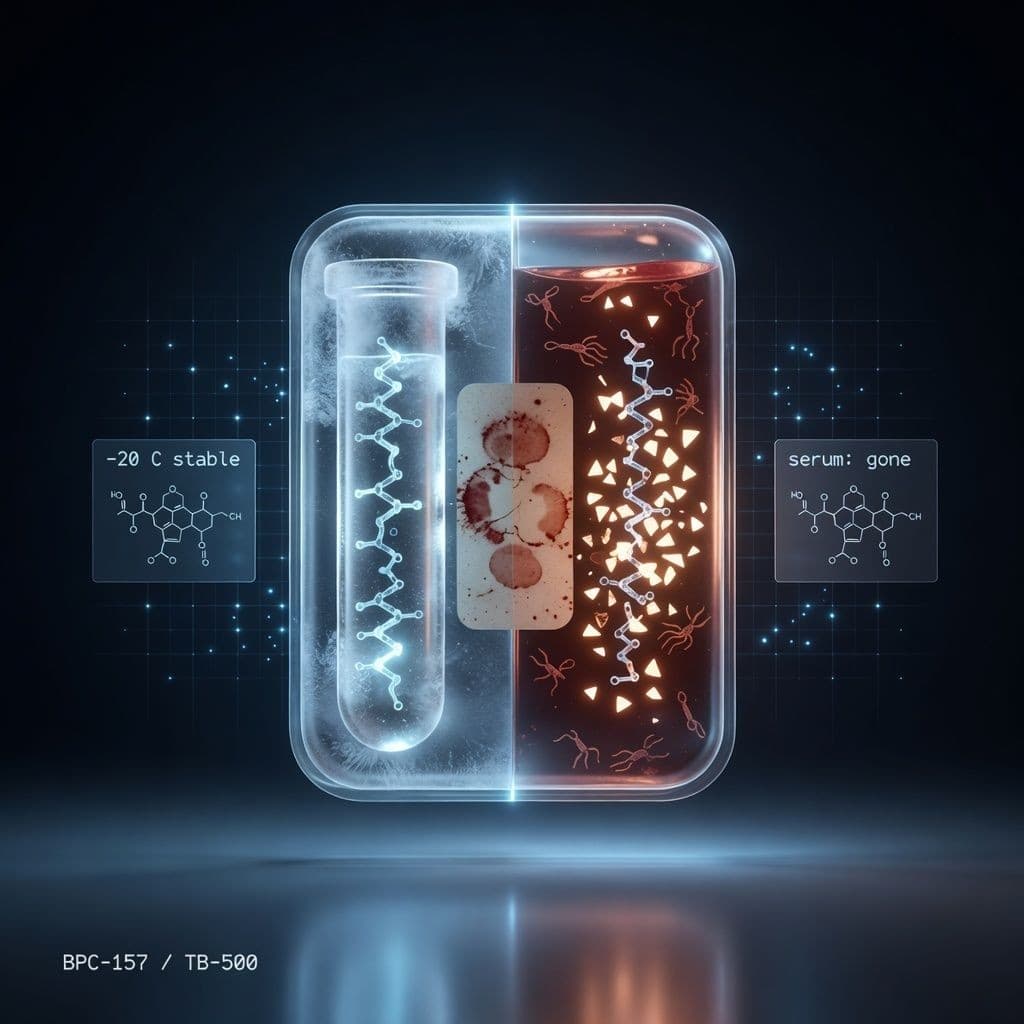
Key finding: At 4 and 22 degrees Celsius, complete degradation was reported for BPC-157 and TB-500 only in serum, not in plasma. In dried blood samples, all 54 tested substances remained detectable for the entire study duration, and at minus 20 degrees everything also remained stable.
The most important sentence: These are spiked blood samples from doping control. The study says nothing about the shelf life of an unopened vial and nothing about reconstituted peptide in bacteriostatic water.
Why it is interesting anyway: There are hardly any independently measured figures on the matrix stability of these two peptides, and these ones do not come from a vendor.
BPC-157 is a synthetic 15-amino-acid gastric pentadecapeptide, studied in rodent and cell-culture models for angiogenesis, cell migration and nitric-oxide pathway activity. Lyophilized powder, specified purity at or above 98% (HPLC), batch CoA.
TB-500 is synthetic thymosin beta-4, the full-length 43-amino-acid actin-binding peptide (about 4963 Da, CAS 77591-33-4), confirmed by a third-party Janoshik CoA. Studied for actin binding, cell migration and angiogenesis in model systems.
A pre-mixed vial of BPC-157 and full-length thymosin beta-4 (TB-500) at a fixed 1:1 composition, 10 mg = 5 mg each, 20 mg = 10 mg each. Purity reported per component on a batch-specific Janoshik CoA.
Angiogenesis, cell-migration and wound-model peptides
What the Study Was Actually About
The paper is not an efficacy study and was never intended to be one. An analytical laboratory wanted to build a faster method for detecting 54 prohibited peptidic and non-peptidic substances in blood samples, in dried blood spots as well as in liquid serum and plasma.
Method in Three Sentences
Sample preparation consists of a single microextraction step with 500 microlitres of a methanol-water mixture in an 8 to 2 ratio. Detection is carried out via liquid chromatography coupled with high-resolution mass spectrometry. The limits of detection ranged from 0.05 to 1.25 nanograms per millilitre, recovery ranged from 15 to 80 percent.
Validating such a method requires knowing how long the target substances actually survive in the sample. If a peptide degrades in the sample before it reaches the instrument, you measure nothing, no matter how good the instrument is. That is precisely why stability was tested systematically. And this side aspect of the study is the part that is interesting for peptide research.
The Key Finding: The Matrix Decides
At 4 degrees Celsius and at 22 degrees Celsius, that is, refrigerator and room temperature, two groups became visible.
The first group had largely degraded after one week in both serum and plasma: alexamorelin, AOD-9604, buserelin, hGH 176-191, kisspeptin-10 and LHRH.
The second group showed complete degradation only in serum: BPC-157, TB-500, vasopressin, lypressin and terlipressin.
This is the actual finding, and it is more subtle than it looks at first glance. The paper reports complete degradation for BPC-157 and TB-500 exclusively in serum. That does not mean nothing happened in plasma, only that no complete degradation was observed there. The difference, then, is not down to the peptide alone, but to the environment.
Serum and Plasma Are Not the Same Thing
Both are the liquid component of blood, but they are produced differently. For plasma, clotting is inhibited with an additive and the unclotted blood is centrifuged. For serum, the blood is allowed to clot and the supernatant is taken off. In the process, the entire clotting cascade runs its course, a chain of proteases that activate one another. Whether, and to what extent, the two matrices differ in protease activity as a result is something the study did not measure.
An obvious explanatory approach would be enzymatic breakdown. The study did not, however, investigate the mechanism, nor did it determine where the two matrices differ here. It reports what happened, not why. Anything beyond that would be our speculation, and we label it as such.
What Happened When Dried and Frozen
Two further results belong to the same experiment.
In dried blood samples, that is, blood dropped onto a filter card and dried, all 54 substances remained detectable for the entire study duration. The authors draw the practical conclusion that such samples can be transported and stored without refrigeration, which saves cost.
At minus 20 degrees Celsius, all substances likewise remained stable for at least two months, defined as a deviation of under 15 percent, across all blood matrices tested.
Within the blood matrices examined, dried and frozen samples performed better than liquid and warm ones. That ranking is not surprising, but it was measured here across 54 substances at once, and that is rare.
What This Study Explicitly Does Not Say
This is the point where a summary can easily overreach, so we will say it plainly.
Not Transferable to a Vial
Measurements were taken in spiked blood, that is, in blood samples to which the substances were added in the lab. This is a biological fluid full of active enzymes.
A lyophilised peptide in a sealed vial is the opposite of that: dry, and without the enzymes of a bodily fluid. Reconstituted peptide in bacteriostatic water sits somewhere in between, but it is likewise not a blood matrix.
This study therefore supports no conclusion about how long an unopened vial keeps, how long reconstituted peptide stays usable in the refrigerator, or whether a vial is still fine after a warm transport. Anyone applying the serum figures to these questions is working from the wrong premises.
Just as little does the study say anything about efficacy, safety, or any use in humans. It describes a detection method.
What Can Still Be Taken From It
We consider three things solid enough to state.
First, sensitivity is substance-specific, not a blanket rule. AOD-9604 belonged to the more sensitive group and had largely degraded in both liquid matrices after one week. For BPC-157 and TB-500, complete degradation was observed only in serum, which does not rule out partial degradation in plasma. Anyone who talks about peptide stability in a single sentence is speaking imprecisely.
Second, in this matrix it happened fast. One week at refrigerator temperature was enough for complete degradation in serum. What follows from that for reconstituted peptide is nothing: bacteriostatic water is not an enzyme-containing bodily fluid, and the study did not examine that case.
Third, within the blood matrices examined, dry and cold came out ahead. Why peptides degrade in the first place is something we cover separately in the article on the chemistry behind peptide degradation. The value of this paper lies in the fact that the figures come from an independent source with no commercial interest in the outcome.
Where Our Practical Guidance Lives
We keep concrete guidance on storage, transport and handling separate from study findings, so it stays clear what was measured and what was inferred. See Storing peptides correctly, Handling, cycling and shipping stability and Why does my peptide turn cloudy.
Context: Why Anti-Doping Analytics Is Relevant to Us At All
Doping control laboratories have an interest that partly overlaps with that of a research supplier: they need to know how long a substance remains detectable in a sample, and they cannot afford to get it wrong. Their stability data therefore arise under methodological pressure and without any sales interest.
For us, that means such papers are one of the few independent sources in which substances like BPC-157 or TB-500 turn up quantitatively at all. Unlike approved drugs, both have practically no clinical data base. What gets measured about them almost always comes from animal models, cell culture, or exactly this kind of analytical work.
Individual peptides
BPC-157 is a synthetic 15-amino-acid gastric pentadecapeptide, studied in rodent and cell-culture models for angiogenesis, cell migration and nitric-oxide pathway activity. Lyophilized powder, specified purity at or above 98% (HPLC), batch CoA.
TB-500 is synthetic thymosin beta-4, the full-length 43-amino-acid actin-binding peptide (about 4963 Da, CAS 77591-33-4), confirmed by a third-party Janoshik CoA. Studied for actin binding, cell migration and angiogenesis in model systems.
As a blend
A pre-mixed vial of BPC-157 and full-length thymosin beta-4 (TB-500) at a fixed 1:1 composition, 10 mg = 5 mg each, 20 mg = 10 mg each. Purity reported per component on a batch-specific Janoshik CoA.
GLOW is a co-lyophilized vial holding GHK-Cu, BPC-157 and TB-500 at a fixed 50:10:10 mass ratio, 70 mg total. Each peptide has its own published literature; no study has tested the three together. Per-component content on the batch CoA.
Accessories for reconstitution
Made in the EU: sterile bacteriostatic water (WFI-grade water with 0.9% benzyl alcohol), produced in Spain in ISO 13485 and ISO 9001 certified facilities, 0.22 µm sterile-filtered and aseptically filled, near-neutral pH 6.2 to 6.4. The standard solvent for reconstituting lyophilized research peptides, with a lot-specific certificate of analysis. Sealed 10 mL vial, ready to use.
Transparent storage box with 10 individual compartments for 1-3 ml peptide vials. Stackable, fridge-friendly, travel-safe. Ideal for organising bacteriostatic water, GLP-1, BPC-157, and similar vials.
What the Community Asks, and What the Literature Does Not Say About It
The most common question in the forums and vendor FAQs we reviewed is not the one about serum versus plasma. It is: refrigerator or freezer, and how many days does reconstituted peptide last.
The answer we most often encountered there is: refrigerator yes, freezer never, 28 to 60 days. None of the pages we reviewed cited a stability study behind these figures.
The handling guidance from an established peptide manufacturer says something different for peptide solutions in general. It states that peptide solutions should be aliquoted and frozen below minus 15 degrees Celsius, and that solutions are best aliquoted before freezing to avoid thaw and refreeze cycles that stress the peptide. It further advises against long-term storage in solution, especially for peptides with Asn, Gln, Cys, Met or Trp residues, and names a pH range of 5 to 7 as favourable (Bachem, Handling and Storage Guidelines for Peptides).
That is general peptide chemistry, not a statement about BPC-157 or TB-500 specifically. We cite it because it contradicts the widespread forum rule, and because nobody resolves this contradiction.
The Honest Gap
To date, there is no published study that measures BPC-157 or TB-500 in exactly the form the storage claims refer to: reconstituted in bacteriostatic water, in a glass vial, refrigerated, over the 28 to 60 days claimed on the pages we reviewed.
The community's most frequently asked question currently has no answer in the primary literature. This study does not supply one either, it measures detectability in a biological matrix, not the shelf life of a preparation. None of the pages we reviewed cited a published measurement for the day counts stated.
There is also a forum dataset in circulation on degradation at room temperature, collected via UV-Vis spectrophotometry. It concerns tirzepatide, MOTS-c and mazdutide, not BPC-157 or TB-500, is unpublished, comes from a single source, and has never been independently repeated. It is not fit to serve as evidence for the two peptides discussed here.
When a Peptide Goes Bad, Storage Is Not the Only Explanation
A peer-reviewed netnography of a British online forum (Turnock and Hearne, 493 threads, nearly 15,000 posts) documents a user whose TB-500 and BPC-157 turned into a gluey mass in the refrigerator after mixing. What stands out is the reaction in the thread: the cause was not sought in storage there, but in the seller.
There is a number for that. Swiss customs authorities had 1190 seized doping products analysed (Substance Use & Misuse, PMID 28156209). For 146 of them, that is 12 percent, the label indicated peptide hormones or growth factors. Across the entire sample, fewer than 20 percent of the products contained the stated substance in the stated amount.
Putting This Number in Context
This is a sample of goods seized at the border from 2017, not a random sample of the market. It says nothing about what is in any particular vial, and it does not allow a comparison of how often product identity, versus storage, is the cause. It merely shows that product identity is a serious question in this field at all.
For every one of our batches, a certificate of analysis from the respective laboratory is available, viewable on our CoA page. These certificates document the results the lab reported for the sample tested. They are not long-term stability data, and we do not test ourselves.
Frequently Asked Questions
Source
Rapid and harmonized analytical workflow for the determination of peptidic and non-peptidic doping agents in dried and liquid blood matrices. Analyst, Royal Society of Chemistry, published electronically on 27 July 2026. PubMed ID 42328738.
For research purposes only. Not for human consumption. Nothing in this article is medical advice, a dosing recommendation, or a promise of a cure. The substances described are not approved as pharmaceutical drugs.
Research context for English-speaking buyers
Most of our English-speaking customers ship to the UK, Ireland, Malta or other English-as-second-language EU territories. The regulatory picture differs per country.
- Relevant authorities
- MHRA (UK, post-Brexit), HPRA (Ireland, EU-aligned), FDA Section 503A bulks list (US, restricted Cat 2 status of several peptides as of 2026)
- Customs and VAT
- EU shipments include VAT, the rate depends on the destination country; UK shipments after Brexit are now extra-EU and may attract UK VAT plus a handling fee at import
- Typical shipping window
- EU 2-4 working days, UK 4-7 working days, other international 7-14 working days, depending on customs
Research-grade peptides shipped from our EU warehouse are sold for laboratory use only and are not authorised for human or veterinary therapeutic application in any of the destination jurisdictions. US customers should be aware that the FDA Section 503A bulks list classification (and the April 2026 reclassification of twelve compounds) only governs compounding pharmacies, not direct-to-researcher imports for non-clinical work. UK buyers should declare the consignment on import and may be asked for a research justification by HMRC. We provide a CoA per batch identified by colour code rather than serial number; customs sometimes asks for this document when clearing the parcel.