Peptide Won't Dissolve? The Complete Fix-It Guide
Cloudy, gelled or undissolved peptide? The complete rescue guide: the quick fix ladder, acid-first recipes with exact volumes for AOD-9604, Tesamorelin and CJC-1295, what never to try, and when to stop.
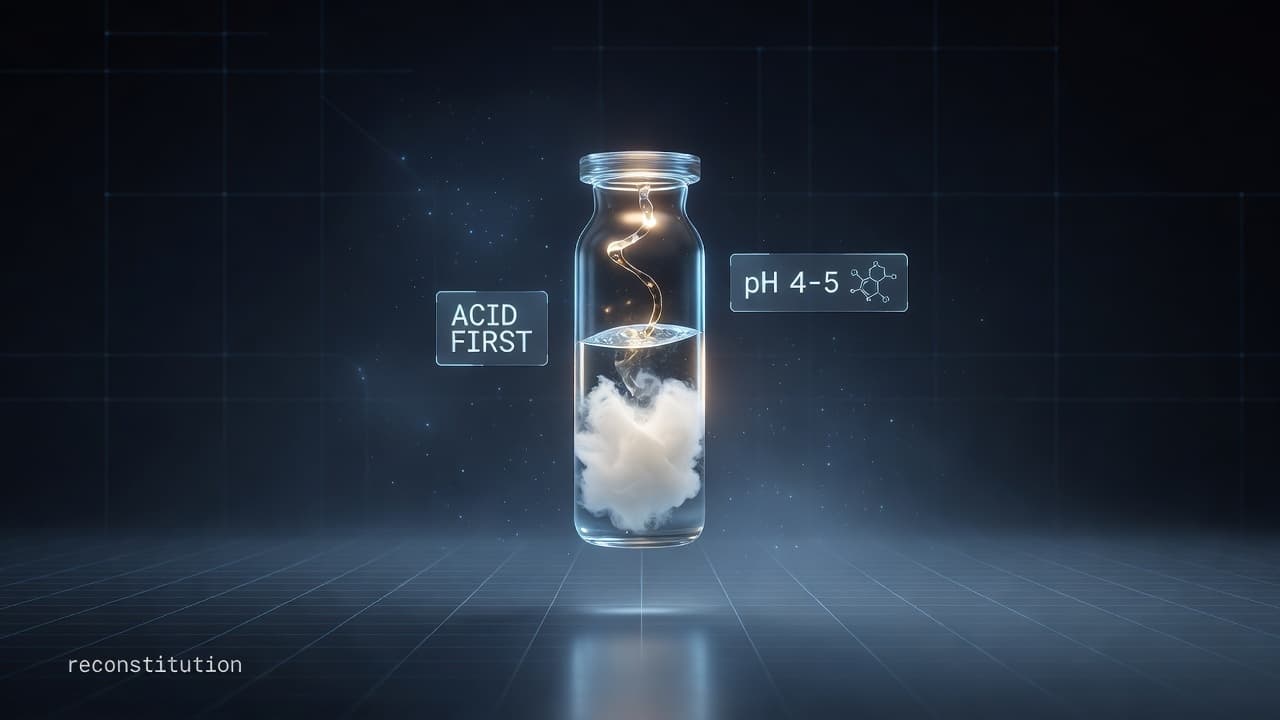
TL;DR: a stuck vial is usually a strategy problem, not a quality problem
The 30-second version: bring everything to room temperature, use enough volume (2 ml or more per vial), let the liquid run down the glass wall, swirl gently, never shake, and judge only after 10 to 15 minutes of rest. For the known troublemakers (AOD-9604, Tesamorelin, CJC-1295 and blends): dissolve the powder in a small amount of dilute acetic-acid water FIRST, then top up with bacteriostatic water. Exact volumes below. Golden rule: a gel that forms in near-neutral water can rarely be rescued afterwards. Acid works as prevention, not as an antidote. Hard stop: solid flakes, strands or discoloration after resting are usually beyond technique. Stop and use our replacement process.
Dilute 0.6% acetic-acid diluent at around pH 3.8, for reconstituting research peptides that stay cloudy in plain bacteriostatic water, such as IGF-1 LR3 and Cagrilintide. Two-step protocol. Each vial is sealed and ready to use.
USP-grade sterile water with 0.9% benzyl alcohol (near-neutral, pH 6.2 to 6.4) - the standard solvent for reconstituting lyophilized peptides. Essential accessory for any peptide research. Each vial is sealed and ready to use.
Bacteriostatic water and research supplies
"My peptide will not dissolve." "Why did my peptide turn to gel?" "Is the AOD supposed to be cloudy?" These are some of the most-searched questions in peptide research, and they usually come with the same worried subtext: did I get a bad product? In most cases, no. Some peptides are simply hard to dissolve, by their chemical nature, and they stay hard to dissolve no matter which shop the vial came from. What separates a frustrating evening from a clear solution is strategy, not luck.
This guide is the practical half of a pair. If you want to understand why peptides turn cloudy (isoelectric points, water pH, concentration effects), read our companion piece Why Does My Peptide Turn Cloudy?. This article is purely about what to do: the general first-aid steps, the peptide-specific rescue recipes with exact volumes, the advanced options for stubborn vials, and the point at which you should stop trying and let us take over. As with everything we publish, this is general laboratory information for research use, not a guaranteed protocol, and the final choice of diluent, volumes and technique lies with you as the researcher.
The quick fix ladder
Work down this ladder in order. Each step is cheap, and most vials never need step three.
Step 1: Room temperature, enough volume, gentle technique
Cold powder plus cold water can flocculate on contact, and cramped volumes push sensitive peptides toward aggregation. Let vial and water warm up for 10 to 15 minutes, plan 2 ml or more of total volume per vial, run the liquid slowly down the inside wall, swirl gently, never shake.
Step 2: Rest before you judge
A fresh haze is often just dissolving in progress. Let the vial stand upright at room temperature for 10 to 15 minutes, swirl once more, and assess against a white background. Bubbles and foam from handling settle in the same window.
Step 3: Acid first (the sensitive-peptide method)
For peptides that are known to gel near neutral pH, dissolve the powder in a small amount of dilute acetic-acid water first, and only then top up with bacteriostatic water. The per-peptide volumes are in the recipes below. This is prevention: it works on the next vial, not on an already-gelled one.
Step 4: Stop and escalate
Solid flakes, strands, discoloration, or a gel that survived a correct acid-first attempt are beyond home rescue. Take photos against a white background and contact us; the replacement process is described at the end.
My peptide will not dissolve: what to try first
Before any special chemistry, three general moves solve the majority of cases.
Give it time, undisturbed
The single most underrated fix. Lyophilized cakes do not dissolve on contact; some densely packed cakes need 10 to 15 minutes of quiet contact with the liquid. Set the vial down, leave it alone, then swirl gently in circles. Do not keep agitating it every thirty seconds: repeated agitation whips in microbubbles that look exactly like cloudiness and can shear sensitive molecules into aggregation. If nothing has visibly improved after 15 to 20 minutes of rest and one gentle swirl (10 to 15 minutes is the usual assessment window, 20 is a practical ceiling), more waiting rarely changes the outcome; move to the next strategy instead.
Bring everything to room temperature, and stop there
Reconstituting straight from the fridge is one of the most common self-inflicted problems: cold shock can flocculate sensitive peptides on contact. Both the vial and the water should sit at room temperature before mixing. The ceiling matters just as much: do not warm a mixed vial on a radiator, in warm water, or in your hands for minutes at a time. Heat accelerates chemical degradation of peptides significantly, so warming is a way to ruin a vial slowly while trying to save it quickly. Room temperature is the working range; there is nothing to gain above it.
Add more volume, if concentration is the problem
Dissolving 10 mg in 1 ml forces a high concentration, and high concentration is one of the known drivers of aggregation for sensitive peptides like the ones in this guide. Moving to 2 or 3 ml total volume lowers the concentration and often prevents the problem entirely; our reconstitution calculator recalculates your units automatically. One important caveat: more water only fixes concentration-limited cloudiness. If the peptide is pH-limited, which is the case for the gel-formers below, extra near-neutral water rarely helps. That is when the acid-first method earns its keep.
Peptide-specific rescue recipes
These are the vials our support team sees most, with the routine that has worked best for each in our own bench tests and support cases. One honest note: our earlier guidance defaulted to plain bacteriostatic water for several of these peptides; the acid-first recipes below reflect what we learned from a wave of support cases and our own tests in August 2026, and they are what we now recommend. All pH figures are rough guides that depend on your specific water; our bacteriostatic water sits at pH 6.2 to 6.4 and our Acetic Acid Water measures at about pH 3.8, with each batch's measured value on its certificate. The finished-mix pH figures below are estimates from those starting points and our own bench tests, not measured specifications.
AOD-9604: plan on acid from the start
AOD-9604 is the stubbornest peptide in our range, and the honest advice is to treat it as a peptide that simply needs dilute acetic acid. Searches like "how to reconstitute AOD-9604 without it gelling" usually end at the same recipe. Choose your end volume (2 ml is common). Run 0.3 to 0.5 ml of dilute acetic-acid water slowly down the inside wall first and swirl gently until the powder has visibly dissolved in the acid; give it one to three minutes. Only then top up with bacteriostatic water and swirl gently once more. The finished mix lands, as a rough guide, around pH 4.2 to 4.8, which is where AOD-9604 dissolves most reliably. Plain bacteriostatic water can work with AOD: supplier data relayed in an FDA advisory briefing reports water solubility up to about 2 mg per ml, while the same briefing calls the peptide poorly characterized. In our support cases the acid-first route is what has separated clear solutions from evenings of frustration.
Tesamorelin: acid first, slightly less of it
Tesamorelin is a GHRH analog, a family whose solutions are most stable in the mildly acidic range. With plain near-neutral water at high concentration it can gel or throw particles even with careful technique. The recipe from our own bench test: 0.2 to 0.4 ml of dilute acetic-acid water first (0.3 ml gave a clear solution in our test), powder dissolved in it, then topped up with bacteriostatic water to 2 to 3 ml total for a 10 mg vial. Judge after 10 to 15 minutes of rest. The finished mix sits, as a rough guide, around pH 4.5 to 5.2.
CJC-1295 and the CJC/Ipamorelin blend: a small acid start is enough
CJC-1295 belongs to the same GHRH family, and in our support cases it is consistently the CJC part of the blend that struggles while Ipamorelin dissolves easily. How much it struggles varies with the salt form and lyophilization of a given batch, which is why two vials of nominally the same peptide can behave differently. Here a small acid fraction usually does it: 0.1 to 0.2 ml of dilute acetic-acid water first, then top up with bacteriostatic water, 2 ml or more total. The finished mix lands, as a rough guide, around pH 5 to 5.5, comfortably inside the window where CJC dissolves well. Assess only after 10 to 15 minutes; these blends often look uneven at first and then come around.
IGF-1 LR3 and Cagrilintide: the classic acid peptides
These two lean acidic by class: the closest approved analogs are acid-buffered formulations (the IGF-1 drug Increlex at a mildly acidic pH, the amylin analog Symlin at about pH 4). Our recommendation from that anchor and from practice: use the acid-first route with a generous acid fraction, dissolve fully in the acid, then top up with bacteriostatic water. Haziness in plain bacteriostatic water is common with both and is not by itself a defect.
Retatrutide and other GLP-1 class peptides: no acid, more patience
Here the strategy flips. The approved products closest to Retatrutide and Tirzepatide (semaglutide and tirzepatide injections) are formulated near neutral, and our own guidance for these two peptides is therefore near-neutral water and no acid. Formulations across the wider GLP-1 family vary, so treat this as our product-specific protocol rather than a law of the class. If a GLP-1-class vial turns milky, the usual causes are concentration and water quality: use 2 ml or more of good, fresh, near-neutral bacteriostatic water, mix gently, and give it 10 to 15 minutes. A brief haze that clears is commonly reported with these peptides and is not by itself a defect. Persistent milkiness points at the water first; testing your water's pH before mixing is cheap insurance.
All the peptides from these recipes, in one place:
Acid-first candidates
Modified hGH fragment (177-191) studied for fat metabolism and lipolysis research. Interacts with beta-3 adrenergic receptors without growth-promoting effects.
Modified GHRH analog for lipodystrophy and metabolic liver research
CJC-1295 without DAC (Mod GRF 1-29) is a short-acting GHRH(1-29) analog for GH/IGF-1 research. Research-grade lyophilized powder, specified purity >=99% (HPLC). Laboratory use only.
2-in-1 growth hormone blend: CJC-1295 no-DAC (Modified GRF 1-29, 5 mg) + Ipamorelin (5 mg) combined in one vial. The CJC-1295 component is the short-acting no-DAC variant (about 30 minute half-life), not the long-acting DAC form. Stimulates natural GH release through two different pathways for amplified, more physiological growth hormone pulses.
Classic acidic reconstitution
Long R3 variant of Insulin-like Growth Factor 1, modified for reduced IGFBP binding and ~20-30 hour half-life. Researched for cell proliferation, hypertrophy, and metabolic signaling. ≥99% purity.
Long-acting amylin analog studied for once-weekly satiety and appetite control. Phase 3 REDEFINE trials complete, NDA filed with FDA December 2025. A mechanism distinct from GLP-1 agonists.
Near-neutral, no acid
First-ever triple-action weight management peptide targeting three receptors at once: GLP-1, GIP, and glucagon. Shown exceptional results in Phase 2 trials - up to 24% weight reduction. The most advanced metabolic peptide available.
A first-in-class dual GIP and GLP-1 receptor agonist, and one of the most extensively studied compounds in modern metabolic and weight-regulation research. Supplied as a lyophilised research peptide with a per-batch certificate of analysis, for laboratory and in-vitro use only.
Copper peptides: never acidify
GHK-Cu, GLOW and KLOW must not be acidified at all; acid attacks the copper complex itself. Their blue to blue-green color is the copper and is completely normal. Near-neutral bacteriostatic water, gentle technique, done.
Advanced techniques for genuinely stubborn vials
Dilute acetic-acid water, the right way
Everything in this article uses dilute acetic-acid water: a mildly acidic, sterile reconstitution diluent like our Acetic Acid Water, which measures at about pH 3.8. Dilute acetic acid is the approach vendor guides and formulation practice converge on for hard-to-dissolve peptides. The order is the whole trick: powder meets acid first, dissolves in the most favorable environment, and only then does the volume get topped up to the target with bacteriostatic water. Adding acid to an already-gelled near-neutral mix rarely works; we have watched customers add acid twice to a gelled vial with zero effect, which matches the chemistry: prevention, not antidote.
A bath sonicator, if you own one
Labs use ultrasonic baths to speed up dissolution, and in an equipped laboratory with instrument-specific, validated procedures it is a legitimate tool. It is not part of our guidance for a typical research setup: sonication parameters that suit one peptide and one instrument can drive another into aggregation, and published work shows ultrasound itself can aggregate proteins. If you do not already have a validated sonication procedure for your specific setup, skip it; the acid-first method addresses the same problems for less money and less risk. A probe sonicator has no place on a research vial in any case.
What not to try
A few internet suggestions belong in the bin, and knowing why protects both your vial and you. Household vinegar is roughly 5 percent acetic acid, far stronger and far more acidic than any proper reconstitution diluent, plus it is not sterile and carries flavor compounds; the answer to "can I use vinegar instead of acetic acid for peptides?" is a clear no. Glacial or concentrated acetic acid is corrosive lab chemistry with no place in this workflow. Sodium hydroxide and other strong bases can dissolve acidic peptides in principle, but without exact molarity and experience you will destroy the peptide; we deliberately publish no protocol. DMSO appears in lab assay contexts but has no business in a research vial workflow like this one. And heating a mixed vial trades a visible problem for an invisible one: degradation you cannot see.
When to stop and let us take over
Rescue attempts have a natural endpoint. Stop when you see any of these: solid flakes or strands that survive resting, discoloration (yellow, pink, amber; the copper blue of GHK-Cu products is normal), a gel that formed despite a correct acid-first attempt, or a vial that stays milky after clean technique, generous volume and suitable water. At that point the vial has told you everything it is going to.
Take photos against a white background with the label or cap color visible, and contact us with your order number. How this is handled is written into our terms transparently: reconstitution happens in your lab and is your responsibility as the researcher, our guidance is orientation, not a guarantee, and reading the product-specific instructions on the product page before you open a vial is part of that responsibility. Alongside your statutory rights we run a voluntary replacement program: if you reconstituted with a recognized diluent (our own water range, or factory-sealed pharmaceutical water with a legible batch) and followed the product-specific protocol (acid first for AOD-9604 and Tesamorelin, as described above), we replace an affected product once, free of charge, after photo review. Skipping the acid step on an acid-first peptide is a handling error, not a defect, and is not covered; a replacement in that case is goodwill in the individual case at most. That single free replacement exists because we know these peptides are genuinely tricky; it is goodwill, and the reason we publish guides like this one is so you never need it.
Frequently asked questions
For research use only
All products are sold strictly for laboratory and educational purposes, with no quality or therapeutic claims, and are not for consumption by humans or animals. Reconstitution, including the choice of diluent, volumes and technique, is part of the research work and lies with the customer. This article is general laboratory information, not a guaranteed protocol and not medical advice.
Research context for English-speaking buyers
Most of our English-speaking customers ship to the UK, Ireland, Malta or other English-as-second-language EU territories. The regulatory picture differs per country.
- Relevant authorities
- MHRA (UK, post-Brexit), HPRA (Ireland, EU-aligned), FDA Section 503A bulks list (US, restricted Cat 2 status of several peptides as of 2026)
- Customs and VAT
- EU shipments include 19% VAT; UK shipments after Brexit are now extra-EU and may attract UK VAT plus a handling fee at import
- Typical shipping window
- EU 2-4 working days, UK 4-7 working days, other international 7-14 working days, depending on customs
Research-grade peptides shipped from our EU warehouse are sold for laboratory use only and are not authorised for human or veterinary therapeutic application in any of the destination jurisdictions. US customers should be aware that the FDA Section 503A bulks list classification (and the April 2026 reclassification of twelve compounds) only governs compounding pharmacies, not direct-to-researcher imports for non-clinical work. UK buyers should declare the consignment on import and may be asked for a research justification by HMRC. We provide a CoA per batch identified by colour code rather than serial number; customs sometimes asks for this document when clearing the parcel.